
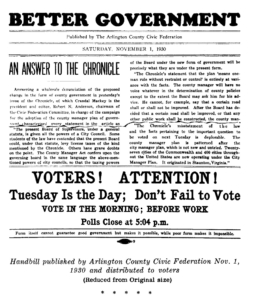
Better Government Voter Handbill
In the summer of 1930, Arlington County had a population of about 26,000 residents. More than half of them had moved in since the start of World War I. A steady influx of new citizens has crossed the Potomac River, drawn by the open land and the natural beauty of the rolling hills. These newcomers, from almost every state, brought diverse experiences in local government, shaping a vibrant political and public affairs scene unmatched anywhere else in the country. Government workers, restricted by Civil Service rules from participating in partisan politics, found outlets for their civic energies through citizens’ associations and clubs. This mix of people from all states created an active political environment hard to find elsewhere in the nation.
During this historic period, the County had several achievements. It proudly operated a school system that had ranked first in the state for several years, maintained a model health and welfare unit, provided excellent fire and police protection, had an up-to-date high-pressure water system, recorded the lowest illiteracy rates, and boasted the highest per capita wealth in the state. However, these accomplishments were achieved despite, rather than because of, the county’s system of government.
By the summer of 1930, Arlington County’s government, which had been in place for several years, was operated by a three-member Board of Supervisors. This board possessed both legislative and executive powers. It held complete control over and exclusive jurisdiction of issues related to roads, sidewalks, sewers, water, health, sanitation, welfare, fire protection, zoning, and planning—covering nearly all aspects of daily life for citizens except schools. Historically, this Board had been a focal point of controversy and intense criticism, serving as a storm center and subject to severe debate.
As early as 1922, certain demands arose for the incorporation of Arlington as a city of the first class, but these demands never gained much headway. However, they probably served a useful purpose in that they must have caused a few of the then leaders of the County, foremost among whom was Hon. Charles T. Jesse, Arlington’s Delegate in the House of Delegates at the 1920, 1924 and 1926 sessions, to become familiar with the advantages derived by cities from the city manager plan, and no doubt laid the seed which resulted in the later adoption of the County’s
present form of government.
The lack of a single chief executive comparable to the official found in the national government, the several states, and most cities was regarded by some students of local government during this period as perhaps the most serious weakness in county organization. The newly evolved county-manager plan, patterned after the manager form of government, then
employed in American cities remedied this defect by its two essential features: (1) a relatively small county board serving as the law-making and policy-determining body of the county, and (2) an appointive manager as the principal administrative officer.
As the advantages of the County Manager plan gradually became known to a few County leaders such as Delegate Jesse, it was realized more and more that the form of government originally prescribed by the Virginia Constitution of 1902 was not meeting the needs of those counties where city conditions were fast coming to exist, and even in other counties it was felt by some people that discretion should be given the General Assembly to authorize optional forms. But the Constitution of 1902, in its original form, rigidly set up a scheme of county organization and government, and the General Assembly was powerless to comply with the demands of certain leaders of Arlington for a grant of an improved system.
It became increasingly clear that the form of government originally prescribed by the Virginia Constitution of 1902 was not meeting the needs of those counties which were gradually becoming more urbanized. In its original form, the 1902 Constitution set up a rigid system of county organization and government, and the General Assembly was powerless to comply with the demands of the leaders of Arlington for an improved system.
Consequently, in 1928, an amendment to Section 110 of Article VII of the Constitution was proposed, empowering the General Assembly to pass general laws authorizing other forms of county organization and government. The amendment was passed and subsequently ratified by the people of the state, opening the door for Arlington to adopt a new form of government.
Accordingly, an amendment of Section 110 of Article VII of the Constitution dealing with “Organization and Government of Counties” seemed to present the only real possibility of relief. Foremost in bringing about such an amendment were Arlington’s representatives in the General Assembly, namely, Hon. Frank L. Ball, who began his first term in the State Senate in 1924 and Delegate Jesse, above referred to. While some of their early efforts to secure an amendment to Section 110 did not materialize, these gentlemen, nevertheless, had accomplished much in that they had gotten a good many other members of the General Assembly to realize Arlington’s situation and to begin showing an interest
therein.
In 1926, a general revision of the Virginia Constitution was initiated by the establishment of a Commission, authorized by the General Assembly and consisting of seven members selected and appointed by the Governor, to study the problem and make recommendations on what constitutional changes seemed desirable. Having completed its undertaking, the Commission on March 17, 1927, was invited to address the joint assembly in a special session called by Governor Harry Flood Byrd. The Commission’s Report dated February 16, 1927, appearing as Document No. 2, House Journal, special session, 1927, p. 8 proposed, among other things, an amendment to section 110 of the constitution which would empower the General Assembly to pass general laws authorizing other forms of county organization and government, which forms must be sub- mitted for adoption to popular vote. Both Senator Ball and Delegate Jesse had participated in preparing this proposal. Senator Ball, at the time, was on the Senate committee on courts of Justice, before which the proposed Amendments were also heard.
On February 14, 1930, Delegate Reid introduced H.8.342 on the House side ” that would add a new chapter to the Code of Virginia to be designated as Chapter 109-a thereof and fourteen new sections to Code numbeted 2772-a to 2773-n relating to the organization and government of counties, and providing for two complete formg of county organization and government, namely, (A) the Modified Commission Form and (B) the County Manager Form either of which was to become effective in any county of Virginia having a population of more than 300.
The Arlington delegation wasted no time, and the 1930 session of the General Assembly passed an Act permitting counties with a population of more than 500 to the square mile (in effect only Arlington) to adopt a County Manager form of government, provided the electorate approved.
And thus election day finally dawned. Over a period of several months, the “Better Government Committee (later assisted by precinct workers) had labored unceasingly to the end that every voter in the County should have complete information on the subject as a basis for an intelligent vote. It was felt that every question that had arisen in the public discussion had been fully answered, and every objection to the change which had been
raised by the opposition had been shown to be without foundation. Also, it should be noted that the outcome of the Committee’s effort, which, if successful, would result in the first adoption by an electorate of the County Manager form of government in the United States, was being viewed with statewide and even national interest.
With the tumult of the campaign having died down it now only remained for the voters in the silence of the voting booth to exercise their choice. On November 4, 1930, the electorate voted for the County Manager Plan and, at the same time, determined that it would elect the members of the new County Board, five in number, from the county at large rather than from the then-existing Magistrate Districts. Recording an almost two-to-one sentiment at the polls (2067 for – 1031 against) for a change in the structure of their government from the existing administration of a Board of Supervisors, the voters expressed an overwhelming preference for the County Manager plan over the Modified Commission form by a vote of 1908 to 485. At the same time, the electorate, by a vote of 1659 to 1179, determined that under its County Manager plan, it would choose the members of its new County Board, five in number, from the County at large rather than the existing magistrate districts.
In only two of the eleven precincts were adverse majorities registered against change in the County’s form of government, and these by very narrow margins. In the Arlington precinct, a vote of 208 to 196 was cast against a change, while in the Ballston precinct, a vote of 176 to 174 was polled against a new form. The varying votes on the several questions presented showed that the people had decided views on the problem presented and a capacity for discrimination.
With this vote Arlington became a pioneer in the County Manager movement, as it is considered to be the first county in the United States to adopt by popular vote any kind of a County Manager system. Over the years, as new demands were placed upon it, the county government structure was enlarged and became more complex. Even in the early thirties, however, concentration of responsibility in a single head resulted in more efficient government. In addition, the fact that the Magisterial Districts had been abolished and the County Board elected at large meant a governing body more responsive to the needs of the county as a whole. To quote C.B. Rose in Arlington County, Virginia: a History: the “continuous, contiguous, and homogeneous” nature of Arlington had now found expression in its form of government.

