
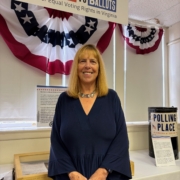
Cathy Hix, Former AHS President, Retired APS Middle School Educator and Administrator
(in-person interview on August 12, 2025 at the Arlington Historical Museum)
[LIGHTLY EDITED FOR CLARITY/READABILITY]
Chris Park: Ms. Hix, you have been the past president of the Arlington Historical Society. You
were also a middle school educator in Arlington from 1979 to 2009, and APS Social Studies
Supervisor from 2013 to 2018, a GMU adjunct instructor, the Virginia Social Studies Middle
School Teacher of the Year, a Library of Congress Fellow, and a USA Today Top 10 National
Team Teacher. How did you start your career in APS?
CH: I always wanted to be a teacher. I got my first chalkboard when I was in kindergarten; I
always played school. So, as a young kid, I would volunteer at summer school. I’d go and help
teachers at summer school. And then when I was in sixth grade in Arlington, I was chosen as
one of the group of kids that got to go and help a special needs PE class. I would have this little
boy. I remember him very clearly. I would help him. It made me feel like… “This is what I want
to do.”
And so I just followed that passion and went on to get a degree in special education and general
education. It made sense for me to return back to the school that I grew up in. Actually, during
my spring break of my senior year in college, I applied. Because there was a passage of a law
called Public Law 94-142 (it was a big special education law), we really started seeing more
classes to support kids with special needs. There was a big hiring need for those kinds of
teachers.
So I came into the County as a teacher of special education. Then later in my career, they
started integrating special ed kids more in the mainstream classroom. So I switched over and
became a mainstream classroom teacher and had special ed kids in my class and started
teaching history. The rest of my career in Arlington…was history, then moving over to Central
Office and eventually supervising history in the County–social studies K through 12.
CP: How do you remember APS schools when you began not only as a student there, but as a
teacher?
CH: I started [in] Arlington schools as a kindergartener at Jackson Elementary when I was five
years old; it was 1963. It was a time of great uncertainty. We were in the beginnings of the Cold
War, and it was a little bit of a scary time. I will tell you a story that’s kind of embarrassing now,
but when I was in first grade, one of my friends was dressed really nicely, and I was like, “Why
you’re dressed so nice today?” And she said, “Because the world is going to end tomorrow.”
And I believed her. The teacher had to give a conversation to the class about how we read the
news, and that doesn’t mean that that’s going to happen. It had to do with the Cold War fear and
bombing. We had bomb shelters in our school so that we could have bomb drills and that we would know that in the event of a bomb from Russia, we would go in and hide. So when you’re
a young kid in first grade, you can’t really conceptualize that; it created fear. The teacher had to
have a conversation with the class about being really careful what we say and choosing our
words.
My education was very traditional. Teachers standing in the front of the room, using their
blackboard, giving information to kids who sat in desks. As I went in later, it got a little bit more
progressive, where we had projects and things like that.
Technology? Light. You know, we had a film strip projector, which is a little thing that you roll. So
we had a film strip projector. I don’t remember any movies as a child. It was a big deal to get to
turn on the film strip projector. But we really didn’t have that much technology. We had books,
paper and pencils, stuff like that, but we didn’t have technology.
We did a lot of field trips back then. Then when I went on to middle school, things got a little bit
more, but it was still very traditional. In high school, you came in, the teacher talked, you took
lessons, and then you took tests. We did have some…it was more engaging, there was more
student involvement, but it was minimal.
The thing I think is really important to talk about, too, is when I was growing up in Arlington,
schools were the main thing in your life. Your sports activities were at the school. I was in Girl
Scouts; it was through the school. Everything was centered in the school. There was no select
soccer, there was no outdoor club, you know, clubs. You basically did a lot of your activities at
your school, or maybe if you went to church, at your church. That certainly did change over the
years.
So I graduated in 1975–a year early because I skipped 11th grade–then I came back in 1979 as
a teacher. It was a little weird because I taught at the same school I attended. I started subbing
and I got a job at the same school. It was like a little weird to go into the teacher’s lounge
because those were all my teachers. Can I call them George now instead of Mr. Long? It was
kind of a weird experience, but back then I was a special ed teacher. My kids were separate
from being in regular classes. Basically, I taught many subjects in their classroom. That
changed as I went along. We started finding ways to integrate students with special needs in the
general education classroom.
We started getting innovations. I had a computer in my classroom in mid-1980s, late 1980s. I
didn’t really know what to do with it because you had to enter in all the codes; you had to code
what you were doing. So it wasn’t really something that we embraced because we really didn’t
know that much about it. I think teaching got a little bit more innovative, more group work, less
traditional sit-and-get, and more engaging instruction. By the end of the 1980s, early 1990s, we changed the system in Arlington to a middle school. It
used to be, you’d go to elementary school, you’d go to junior high, and then you’d go to high
school. So they had this middle school movement and the kids in the middle were the ones that
got lost. We needed to address this. So they put sixth, seventh and eighth grades together.
They grouped the kids by teens, so that they only had five teachers. We all shared, and it was a
little bit smaller, closer environment to help kids. That was great. We did a lot of team building.
We thought it was a really good environment for kids.
Technology was starting to really increase. By the time I ended teaching, kids did not have
tablets, but they were doing interactive work. I had a whiteboard that kids could do things on
the screen–so much more innovative. We had computer labs that kids could go to. We had to
fight to get the lab, and you had to sign up. There was maybe two labs in the school. We knew
about tablets, we didn’t have tablets. I will say, as I was getting ready to leave the classroom,
cell phones were just becoming a thing. My last year, in the classroom, I can remember saying
to kids, “Put away your phones.” That was just unheard of; most kids didn’t have a phone, but it
started coming, and then it really became rampant. You certainly have seen now the pushback
that they’re starting to take them away because they’ve become quite a distraction.
By the time I was a supervisor–and my job was a supervisor of social studies in the County–we
started seeing the introduction of tablets for student learning. Particularly, it was a big fight on
whether little kids needed tablets because there were some people that were like, “Yeah, my
kids have them at home. My [grades] Ks, ones, twos, maybe they should have tablets.” And
people were like, “No. What about books?” And so that became kind of a conversation about
how much screen time do we give kids?
The education transformed [to] having kids have more ownership over their education as
opposed to the teacher being the source of all knowledge. And to me, that’s a good thing,
because to me, good learning is when kids discover, not teachers tell. I always used to say
when I was a supervisor, you need to think in a classroom on who’s doing the most thinking,
talking and creating. If the answer to that is not kids, then you need to rethink how you’re
teaching.
In my last few years in APS, we are creating online courses, everybody had tablets. I was
going into classrooms observing teachers, taking my notes on tablets. It became very
technological. And just even in the science labs, just everything kind of exploded. And that’s
what we see today…although there is some pushback on not computers and tablets being the
end-all-be-all.
CP: I know you briefly touched on the Cold War era. Bringing up another crisis, where were you
during the September 11, 2001 attacks on the Pentagon? What was that day like in school?
CH: I was a classroom teacher. It was around my third period, right before the seventh graders
went to lunch, and I had a note delivered to my door that said, “Turn off your TV and keep your
kids until further notice.” They were worried about, because it was broadcasting, if I was
showing some TV program and the kids actually saw. We wanted to control, not have panic
because living where we live…I had a student on my team, not in my class at that point, but on
my team, whose father (it was a separated home) worked at the World Trade Center.
Fortunately for him, he had a doctor’s appointment that day and he was not in the building. Also
because the Pentagon is in our county, we had a lot of kids whose parents potentially were
there. So what we were told is to keep our kids until further notice. And then we were given
directions so the kids could move to the next class, keep TVs off. We were provided with an
explanation about what happened. Then actually, after my third period, I had a two hour and a
half break where I had my meetings and planning and lunch–and we didn’t do that; the teachers
all went to the office because parents, of course, were running in and grabbing their kids. We
didn’t know if there was another attack. We just didn’t know. And so we had parents, they were
flying to the school and they wanted their kids with them, understandably. What was happening
is parents were going directly to their kids’ classroom; they were crying. So what they decided to
do is have the teachers ferry the kids. I’d be sent to a classroom to pull out a student and say,
“Your mom’s waiting for you. She has to take you home today.” That’s what we did.
I had an additional layer for me because my husband worked down by the Pentagon at the
Navy Yard and had meetings at the Pentagon. I couldn’t reach him. So I was spending my time,
like, I had no phone link, “Has anybody heard anything?” And finally, they did call me and say
that he was in lockdown at the Navy Yard and he was fine. But that was an additional concern
for teachers and educators. In fact, one of the principals in our school system, she lost her
husband, principal of a school down in South Arlington (I can’t remember the name at this
point); her husband was killed on 9/11. So that was a challenge.
We dismissed the kids eventually. A lot of them had already gone because their parents had
picked them up. We were all sent home. One thing I noticed is when I got home, everybody
had their flags out. I mean, it’s just the atmosphere was just a shock, and the flags were out.
People were walking around in silence. We didn’t know what to do. They kept us home the next
day.
They basically got their experts together with counseling and stuff like that because they needed
to give us feedback on what they needed to get to the teachers like, “How do you talk about this
with your kids? What do you say? How are we going to respond?” So we were kept home. Then
when they brought us back, we had directions on this is what we can do to support our students
and that.
There was a lot of rallying around our kids. One of the things that we did that I was a part of is
we did wrap the school in red, white, and blue, and we sold paper chains. We did it by grade
level, like sixth grade was red, seventh grade was white, eighth grade was blue. It was 25 cents a chain. Our goal was to wrap the school in this chain, which we did. We donated the money
we collected to a fund for families who lost someone during the attacks. Other schools did
similar things, just as a show of patriotism.
We have a lot of anger and public discourse right now. But it was a time where everybody’s like,
“Okay, this is our country. We’re going to all come together.” Well, the exception is…because we
are blessed in Arlington to have such a diverse population, it was not that easy…I had one of
my most lovely students, who was not allowed to stay after school anymore because her father
was worried about her because she looked different. She looked like she was Middle Eastern,
and she was afraid. They were afraid that somebody would attack her, so in the goodness that
came in the camaraderie that brought people together for the United States, there was also the
backlash because people became suspect. People that had never been suspect before all of a
sudden we were suspect. It’s just like people going to the airport and looking around and
saying, “Who’s the terrorist?” So it created a level of fear that sadly trickled down to kids.
That’s one of the blessings…and I really didn’t mention it, and it should have come [out] when I
talked about teaching…but one of the big changes also over my years of teaching is a change
in the student population–really, really blessed to see such a diversity, the diversity that came to
our schools particularly in late 1970s, early 1980s. The Vietnamese population was one of the
first to come as a result of the [Vietnam] War. But over the 1980s and 1990s, just some
amazing kids coming in from different countries and really enriching our school experience. But
here was the backlash on people that were so-called (and I put it in quotes) “different” because
there was such a fear. So we had the good. But we also had that real sad part of the 9/11
experience.
CP: I understand that over three weeks in October of 2002, the DC or the Beltway Sniper
Attacks terrorized residents in the DMV area. What do you remember most about this period?
CH: Fear. Cancellations. There was a shooting; there was a sniper shooting at Seven Corners,
which is very near our school. So we kept the kids inside. We had a–I don’t know if you’ve ever
been into Swanson Middle School–but it used to be in Swanson, you could go in the front door
and walk all the way down the hall before they got to the office. So in reality, anybody could
come in and be all over the school and nobody would really know. So we got cameras. We had
a lockdown of all doors. We had a desk right as people walked in the door. They were required
to check in. Sometimes teachers had to monitor that desk. We just put everybody on a
heightened alert.
My teaching style was very active; I did a lot of simulations, and I took my kids every year to the
park. We studied the Civil War; I had a station for learning about Civil War medicine; I had
reenactors that would join us and demonstrate what it was like to be a soldier. We had all kinds
of activities. The administrators were like, “You can’t do it, you can’t be outside.” So we had to
do things inside. But we also had to contend with gym, because they couldn’t have the kids out on an open field. We were in lockdown, basically, continuously until we felt it was safe. It was
scary. I think that when you grow up in this Washington D.C. area where national news is local
news, you tend to be more reactive to events like that.
CP: How do you think these events shaped APS’s resilience?
CH: I think one of the things I have real respect for APS is when those crises occur, they are
really good about responding and thinking about kids. Like I said, we stayed home a day for a
night after 9/11, and they came up with “This is how you deal with it.” We were supported.
I had a student who died of cancer. The counselors are there to give you that support. I know
that when I was a supervisor and there was violence in Charlottesville in 2017 and somebody
was killed, I was asked to prepare talking points for teachers so that they could support
students. So I think it made us aware of we have a young population and we need to make
sure that they get facts. And when social media exploded, teachers can counter and provide
support. So I think that it made us resilient in the awareness that we can be the fact finders and
that our job is to support kids emotionally, through stuff like that.
I think it made us much more security conscious, much more aware. I will tell you, honestly, in
my early days of teaching, I thought nothing of putting a bunch of kids in my car and driving
them home. And now you have an awareness of you really should be careful about those kinds
of interactions. That’s why, even with you, when we contact you, we want to copy your mother.
So it made us more aware of protecting students. It also made us much more security
conscious. We didn’t have locks on doors when I was growing up. Every door and the whole
school was open when I went to school, maybe not during the early days during the Cold War.
During the Cold War, we weren’t afraid that Russia was going to be knocking at our door. But
when you have concerned of issues right in the country, then you’re a little bit more worried; we
became very security conscious–cameras at every school, doors must be locked during the
day. I think that it made us be more aware that there’s a dangerous world out there, but we
have to have a protected space for our kids to learn.
And I think that Arlington has been resilient, being right outside the Beltway and all the variety of
things that go on in DC. I think it has made us more resilient.
CP: What lessons do you think educators should take away from those experiences?
CH: Educators are the front line with students. I believe, and I hope it’s still the case, that
teachers carry weight with students–if you have respect for your teacher, then you respect
what they might have to share with you. I think educators need to be careful with that trust and
that they need to be respectful of what kids need. I think that it’s really important to listen to
your kids. It’s really important to be aware of the needs of your students. My job in the
classroom was to educate my students, but that doesn’t mean that life lessons weren’t important, too. Kids are going to thrive in an environment where they feel safe and protected. I
think a teacher’s role today is to create that environment and to also support them, not just with
their education, but to support them so that they feel safe to learn…because it’s a crazy world
out there, and we need to create a safe place for our kids to be successful.
CP: Thank you. That was great. Before we wrap up, is there anything else you’d like to add?
CK: Growing up in Arlington and growing up as a child, I sat in a classroom and everybody
pretty much looked like me, by the time I went, it was not until I was in junior high school that I
ever had an opportunity to be in a class with somebody that was a African American, and that
was something new. It’s not that I didn’t have interactions with African Americans, but I didn’t go
to school with African Americans; that aligns with the fact that we were not fully integrated in
Arlington County until 1971. So even though we started desegregating our schools in 1959, it
was ongoing. And to me, as I look at the course of me being in school and then me having the
opportunity to teach the populations that have come to our County…At one point when I was in
school, a hundred different languages were being spoken in our County, and the degree that
that has enriched our County and our education, I just don’t think it can be understated. It has
really been eye-opening to me.
I used to teach immigration. We would do a simulation and I’d have kids research their family
heritage. Then we’d turn the seventh grade hall into Ellis Island; they’d have to immigrate
through as that immigrant character. Then when they got done, they sat down and interviewed
new people that were immigrants to hear their immigration story. I just think it’s made us such a
great learning community, because we have so many perspectives from all over the world. That
has been, to me, one of the most amazing changes in Arlington County–to going from
everybody looking alike to the diversity of perspectives and ideas. It just has really enriched our
County and schools and I think that that has been really important.

