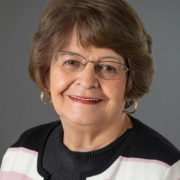
This document presents a transcript of the oral history interview conducted with Dr. Emma Violand-Sanchez, former Arlington School Board Member and Chair, founder of The Dream Project, and creator of the English as Second Language model programs. The interview took place in person at the Arlington Historical Museum on July 18, 2025.
[Edited by Emma Violand-Sanchez 3/15/2026]
CP: Thank you so much for meeting with us today. To begin, could you describe what Arlington was like when you first started working in the school system?
EVS: When I began working in Arlington in 1976, the community was already undergoing changes. Arlington Public Schools had Korean and Spanish-speaking students, and after the Vietnam War, the county welcomed Vietnamese refugees. The population of refugees and immigrants continued to grow over time.
A book titled Arlington: A New Community of Learners documents how programs for immigrants and refugees were established, emphasizing the importance of involving parents in schools. Understanding different cultures and engaging families became central to our approach.
For those arriving in a new country, especially as refugees, personal histories and family stories are significant. These narratives include reasons for migration, sacrifices made, and decisions regarding family separation, all aimed at providing better opportunities for the next generation.
Family values influenced the creation of our support programs. Arlington Public Schools hired staff who spoke the languages and understood the cultures of the families we served, providing crucial support to help them adjust and thrive.
CP: Why was that so important?
EVS: The immigrant experience often fades as generations become more integrated. Students may attend school and start careers, but stories of immigration are rarely found in textbooks. For instance, Korean students may not learn why their families immigrated to the United States or why the Korean community in Virginia is so strong.
Community language schools prepare students academically, including information about local science and technology programs in the schools, reflecting the community’s high regard for education. There is substantial participation from Korean and Vietnamese students in these after school programs.
Parental involvement in schools was a priority. While children often learn English quickly, parents may not speak English, and there were no opportunities to learn within their native language in school systems unless families establish Saturday language schools. Students who do not continue to learn their native language and speak English in schools and socially with friends contribute to language loss and sometimes weakened family communication.
We encouraged immigrant parental participation in schools and worked with them to help children maintain their languages and cultures, recognizing how vital this was for families.
CP: You’ve had a 40-year career in Arlington Public Schools—as a teacher, administrator, school board member, and chair. Looking back, what do you consider your most significant contribution?
EVS: My most significant contribution was creating and developing educational programs for students whose first language was not English. Many of these students were immigrants or refugees.
With the support of teachers, the county, and federal grants, we built strong instructional programs. We offered English as a Second Language and bilingual instruction, striving for students to learn English beyond conversational skills.
Children learn English through interaction, reading, and writing in schools but if native language is not used could lead to losing their first language. Research suggests that when children fully transition to English and their parents do not speak it, connections between parents and children can suffer.
It was essential for students to learn English while also engaging with academic subjects such as social studies, science, and mathematics from the beginning, rather than delaying content learning until English proficiency was achieved. This approach led to the development of High Intensity Language training programs that integrated language and content instruction.
Instruction also included sociocultural learning. Many parents were professional doctors, engineers, farmers, military leaders—in their home countries. We recognized these “funds of knowledge” as strengths, encouraging parents to maintain their language, culture, and values.
Education should be additive, building on what children bring from their families, rather than subtractive, which dismisses culture and language. We promoted continued use of native languages and storytelling at home.
Research by Lily Wong Fillmore highlighted how losing a first language damages family communication, especially between children and grandparents, which I observed firsthand.
CP: Can you share an experience that illustrates that?
EVS: One example involves a Cambodian refugee student at Kenmore Middle School who ran away from home. The police brought her to school, and we needed an interpreter because her mother spoke only Khmer and was illiterate. A bilingual Khmer speaker was needed to facilitate communication between mother and daughter.
Under the Khmer Rouge, families were separated, and the parent-child connection was often lost. This situation underscored the importance of preserving language and culture—not just academically, but emotionally and socially.
This is why we supported Saturday schools and community-based language programs.
CP: You helped create APS’s English for Speakers of Other Languages and High-Intensity Language Training programs, which became a national model. What inspired that work?
EVS: When I arrived in 1976, I was Arlington’s first bilingual teacher. We had bilingual staff in Spanish, Korean, and Vietnamese. Although later government policy limited bilingual instruction, we continued to build strong programs for students.
We partnered with universities such as Georgetown University, George Mason University, and Trinity University, and received federal grants. Georgetown trained ESL and bilingual teachers, while George Mason’s researchers studied our programs and helped identify student needs.
We observed classrooms, documented instructional practices, and contributed to the development of models like the Sheltered Instruction Observation Protocol (SIOP). We also trained bilingual teacher assistants—many of whom had been teachers in their home countries—to become certified teachers in Arlington.
The ability to communicate with parents in their native language proved invaluable for students’ success.
CP: During your time on the school board, APS experienced significant growth. How did you balance expansion with equity?
EVS: Balancing expansion with equity was challenging. As the first Latina elected to the Arlington School Board and with decades of educational experience, I found that much of the work focused on budgets, capital improvements, and construction. The board spent extensive hours discussing projects like new schools, renovations, bonds, and community input, which required substantial investments.
Despite these challenges, I continued to advocate for bilingual education and equity. I advocated for the historic designation of Dorothy Hamm Middle School, preserving the history of integration at Stratford Middle School. I worked to recognize bilingualism as a social, economic, and educational asset, even when some administrators did not fully understand second-language acquisition and bilingualism. I persisted in my advocacy.
CP: What advice would you give to first- or second-generation immigrant students who want to lead like you have?
EVS: What you are doing now—conducting research and collaborating with your family—is learning and a source of strength. You are creating something meaningful that will serve you in college and beyond.
You should articulate why this research matters to you. As a college professor, I found that students who bring such experiences stand out in class.
I recommend that you honor your heritage. If possible, visit Korea and learn the language. Arlington Tech offers not only technical education but also cultural understanding. Diversity will be your strength.
CP: You were also instrumental in founding The Dream Project. What led to its creation?
EVS: In December 2010, the DREAM Act failed in the U.S. Senate by six votes. Shortly after, Virginia’s Attorney General issued guidance to universities to deny admission to undocumented students.
Immigrant parents, students, and supporters gathered at my home and decided to establish a non-profit organization to raise funds for scholarships for students facing barriers due to their immigration status. We created scholarships and mentorships for undocumented students, whom we called Dreamers.
Today, The Dream Project has supported over 100 students. We advocated changes in higher education policy to allow students to attend college as in-state residents. However, many still cannot work professionally because of their immigration status.
Education is key; it is like an anchor that no one can take away from you.
CP: What do you think APS still needs to improve?
EVS: Progress has been made, but ideally, more bilingual education courses should be available. Older immigrant students lose academic time while learning English. Currently, there is fear in immigrant communities due to federal immigration enforcement. Solidarity and support for immigrant families are essential.
CP: Finally, how do you hope your legacy is remembered?
EVS: My book, “Dreams and Shadows: An Immigrant Journey,” represents part of my legacy. More importantly, I hope to be remembered for my commitment to service, community, and advocacy. I believe in the Andean value of ayni—solidarity and reciprocity.
This project is an act of reciprocity. You are giving back to our community by preserving its history.
CP: Thank you so much for your time and wisdom.
EVS: Thank you.

