
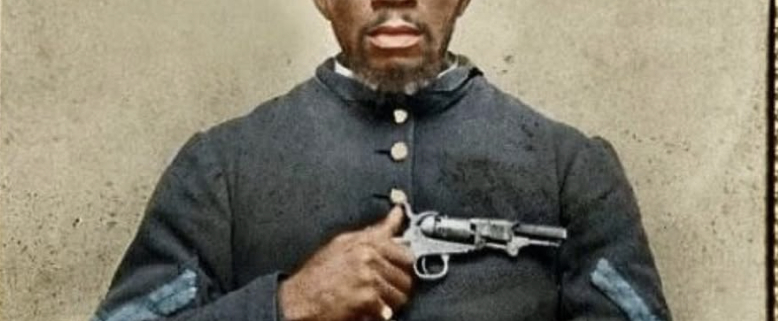
During the Civil War, Arlington was an important center for the US Colored Troops (USCT). Join AHS and the community for an afternoon of commemoration for Camp Casey, one of Arlington’s historical treasures whose exact location was a mystery… until now. As the county dedicates a new historical marker, we’ll hear historians tell the story of the men and women who helped save the United States.
Program
8th Green Machine Regiment Band, George Mason University
Introductions
- Alex Sakes, President, Penrose Civic Association
- Blake Lindsey, Arlington County Parks
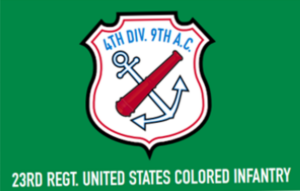
Flag Presentation: Detail, 23rd United States Colored Troops
Keynote Speaker: Edward W. Gantt, Captain USN (Ret.) as “Pvt. Ed Gantt, 23rd USCT”
Speakers
- Dr. Scott Edwin Taylor, Director, Black Heritage Museum of Arlington
- Jessica Kaplan, Co-Coordinator, Memorializing the Enslaved of Arlington
- Dr. Delisha Davis, Director, NAACP Arlington Chapter
- Reverend Ashley Goff, Pastor, Arlingon Presbyterian Church
- Steward Henderson, 23rd United States Colored Troops (Reenacted)
- Craig Syphax, Board of Directors, Black Heritage Museum of Arlington
A Short History of Camp Casey
From 1863 to 1865 Camp Casey in Arlington served as the camp of organization for the only two regiments raised in the County during the Civil War – the Second and Twenty-Third United States Colored Troops (USCT).
The Second, raised from July to November 1863, would go on to serve in Florida and distinguish itself in the battle of Natural Bridge, the second largest Civil War engagement in the state.
The Twenty-Third, raised from December through July 1864, would become the first USCT regiment to engage Robert E. Lee’s Army of Northern Virginia, defeating rebel cavalry at the Alrich Farm near Spottsylvania. It would later suffer the heaviest casualties of all federal regiments in the battle of the Crater.
For the next several weeks USCT soldiers continued to enlist at Camp Casey, and a detachment from the camp participated in the defense of Washington against General Jubal Early’s army during the attack on Washington that in July, 1864 culminated at Fort Stevens.
By September 1864 Camp Casey had become an official Rendezvous of Recruitment for USCT soldiers serving in the armies besieging Richmond, ultimately putting thousands more men into the ranks of nearly thirty regiments. Four of the seven USCT regiments present at Appomattox had men recruited in Arlington, some of whom fired what proved to be among the last shots of the war.
Before the war the land Camp Casey occupied was owned by Richard Williams, a constable of Alexandria who in 1858, on the orders of Robert E. Lee, whipped three people enslaved on the Custis estate who had attempted to escape. Among the greatest ironies of Arlington history is that Williams’ property would later serve to put more than 5,000 United States Colored Troops into the United States Army. Further some of the men recruited here would fight at Appomattox, helping to put an end to the military career of Robert E. Lee, the last master of Arlington House.
During the war Camp Casey not only raised Black soldiers but also gave employment to others, including Charles and William Syphax. They and their employees ran a store on the post catering to soldiers, many of whom had spending money for the first time in their lives. With Arlington itself serving as a magnet for freedom seekers throughout the region, newly self-emancipated Americans, both men and women, also found employment working as teamsters, laborers, nurses, laundresses, and in other occupations.
After the war several new Black communities grew up in the larger neighborhood, including the Butler-Holmes development in Penrose, cofounded by William Henry Butler, a soldier of the Second Regiment, United States Colored Troops.
With the dedication of this historical marker, Arlington’s Camp Casey and the soldiers whotrained here will finally receive some part of the recognition they earned more than a century and a half ago.