
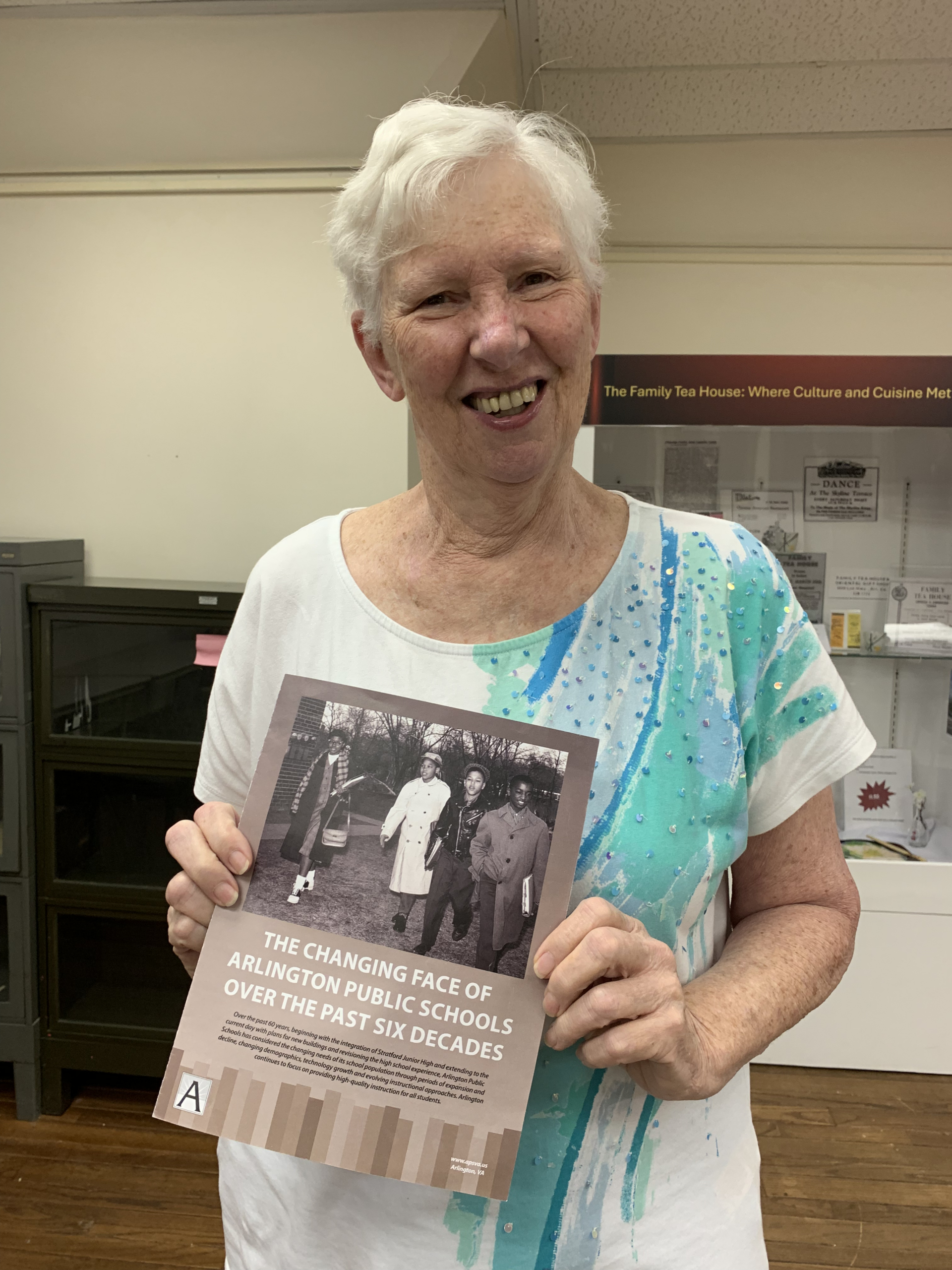
MEG TUCCILLO, Tuckahoe/Abingdon Principal (in-person interview on July 1, 2025 at Arlington Historical Museum)
[LIGHTLY EDITED FOR CLARITY/READABILITY]
CP: I was in the APS system until about second grade, I believe. I went to Arlington Science Focus School.
MT: It was Mary Begley. She was your principal. .. And you have this [APS education history pamphlet]. This is what I wrote. You might want to look at it. And it’s mostly about the changing population.. But it’s, you know. It’s six or seven years old now, but it did from six decades. So, you know, we can reference that too.
CP: Yeah. Sure. Oh, thank you. Oh, thank you. Just for the sake of recording, could you give us a little introduction?
MT: Okay, I’m Meg Tuccillo. I came into the school system as a professional, as a principal at Tuckahoe in 1988. Then I was the principal at Abingdon from 1991 to 1995, then I was the assistant superintendent for Administrative Services. The phrase was always principal for principals from 1995 or 1996 till I retired in 2012. When I retired in 2012, I continued to work for the school system on a consultant basis doing things like documenting some history, doing a lot of boundary change processes, working with facilities and operations and building new schools, working with the transportation department, working with planning and evaluation, and maybe that was it. It’s quite a lot. So I retired and stopped working during the pandemic.
CP: What really brought you into focusing on the history of APS?
MT: You know, it’s interesting. So I’ve told you my professional connection, but I started working in the school system as a parent, advocate, and a volunteer in 1976, probably my daughter was six years old, probably earlier than that. And so just because so many things were happening during that time, my daughter went to Barcroft where we had a large influx of Vietnamese students. And when I became a principal and saw the difference in the diversity of the students in the different schools where I was principal and then as a system. It just intrigued me as to, you know, how did we get where we are and what’s going on. So history has been just an interesting side gig.
CP: In terms of the influx of all the Vietnamese students, do you feel like that was probably one of the bigger moments in terms of APS history, or are there some other ones that you think about?
MT: Oh, well, integration. Yeah, integration. You know, in the recent last 60, 70 years, integration was absolutely the biggest opportunity for us to learn from and grow from and be better and do better. So there would be that. And that happened not long before we had this large influx of, and it started with the Vietnamese population, followed quickly by the Hispanic population, as they say, in the pamphlet, I think it’s like 1980, 1970s, 1980, particularly the Bolivian population. Among our Hispanic families, many of them were Bolivian because of the political issues, and now it has grown much more to be from El Salvador, Guatemala, etc. But those issues were big challenges for the school system to learn from and to adjust to and to adapt and to change, to be responsive to the needs of the changing population.
CP: Do you think in recent years, at least, the past decade or so, APS has been doing a pretty good job?
MT: Yes, I always think we’re doing a pretty good job. You know, there are individual struggles at times when maybe, you know, the best outcome didn’t happen. But I believe that those who have made a decision to work in the school system do it for the right reasons, for the reason to be part of a process that helps give young people and young families every opportunity to live a great life. So, yeah, I do think that people go into it for the right reasons and are doing the best they can.
CP: Also, in terms of recent years, with the 2020 pandemic, how did APS kind of deal with that? Because I’m coming out of a private school, so there I know we dealt with it a little differently.
MT: So did you stay in school?
CP: We did online.
MT: But did you go back earlier? Most of the private schools did.
CP: Yes, we did.
MT: What a challenge. What a challenge. And that was right when I was finishing my tenure. So I was part of the, “Oh my God, this isn’t going to be two weeks.” You know, everybody said, well, March 17th, whatever it was, you know, we said, “Well, we’ll see you in two weeks when this is all over.” And it didn’t happen that way. Doing a quick flip to doing online learning was, you know, as hard for Arlington as it was for anybody, whether you’re working, whether you’re a family, whether you’re a kid yourself. And I think everybody did as well as they could at the time, given what was going on. and not knowing just how long this was going to go. I do think it had an impact on the kids, particularly the younger students in their attention span and their learning style. You know, we talk a lot about multiple intelligences and different learning styles. And when you’re in-person, teachers kind of get a feel for that and can do a project or do a lesson with a couple of different visual stimulations and auditory stimulations and action kinds of things that, you help kids learn in a way that makes that work for them. When you’re doing it online, you don’t have that flexibility. And when you’re a young student learning, beginning to learn how you’re going to learn and knowing more about yourself, I think young kids have continued to struggle with that. That’s certainly been the challenge. I feel like during the COVID period, I think you’re absolutely right. And it was really difficult for a lot of people.
CP: Do you think other than the attention span of kids in school, do you think in terms of school life, like the curriculum, like the general philosophy of that, do you think post-pandemic, there have been like a lot of changes after coming out of COVID?
MT: Well, there have been a lot of political changes, and political changes reflect the society. Absolutely. Now, I think that indeed, there’s a lot of pressure on teachers. That is different than it used to be. There’s a greater challenge and skepticism, maybe, about what’s going on in the classroom. And that leads to stress for the teachers, and I think that I do think we are experiencing a real challenge in continuing to get and maintain really high-quality teachers. I hear folks, their children, my friends’ children, who are young teachers, struggling and maybe making a different life decision because it was just too hard. Too many challenges, too much pushback, too many introductions of limitations about what you can and cannot talk about and learn from. So, yeah, I think it’s been a challenge.
CP: How do you think we as a society, like a community in Arlington, we can accommodate not only the kids, but the teachers, because I understand it must be a lot of pressure in this landscape, as you said.
MT: We recognize the challenges that teachers are facing, and we value and we want to support [them]. One of the things just in recent years, I head up the Education and Workforce Development Committee for the Arlington Community Foundation. And we’ve started doing teacher fellowships, summer fellowships for $5,000. They have an opportunity in the summer to match up with an organization of their choice or something that we can help them with matching up a place to do the internship or the fellowship. But recognizing the value of the work that they do and paying them to have an experience where they can learn more about what’s expected of our kids in the workforce by being there for a month and being tutored or being mentored or shadowing. We’ve had people working at NASA and people working at the [National] Science Foundation and people working at the [Arlington] Career Center. The guy who was the chef teacher there before Chef Renee, I forget his name, but he got a fellowship, so he could spend the summer learning the science of food truck cooking. So he could help young people be entrepreneurs and open their own food truck and know how to do it safely. So giving opportunities and experiences for teachers to learn and to grow and paying them for it, I think that’s one example of helping to let them see that we value them.
CP: Another topic that I wanted to go over was students with disabilities or students [who] require special education. Could you tell me a little more about that? I’ve been having a little trouble finding material on it.
MT: Okay, I was a special ed teacher for 10 years in Prince William County and then came here. And I will tell you the growth of special education in Virginia has been significant. The growth of recognizing the needs of children with special needs. When I was teaching special ed at the elementary level, in the elementary school I was in, there were probably 600 students and self-contained special ed classes. So about 100 kids were in self-contained classes. They shouldn’t have been. They should have been supported and integrated and allowed to be very much a part of the bigger school life. But they were isolated. And that was true in Arlington as well. Kids were, I think the thinking was, “Oh, well, they have such different needs, they need to be alone, they need to be separated. They need to be protected.” And for some small portion, that may be true, but for many more kids than we recognized in the 1960s, 1970s, 1980s, many more kids can be successful.
I’ll tell you when I was a principal at Tuckahoe in 1990, the first autistic, the first child, you’re not an autistic child, you’re a child, you’re a child, and you have an identification that says you have autistic issues. The first child identified with autism to be integrated into the regular classroom was in my school. And it was amazing. I’m going to tell you more than you need to know. It was an amazing experience. He was in first grade. He had a wonderful teacher who was experienced and open and loving. And this young man had a fixation with flushing toilets. The flush of the toilet. It just was a fixation. And in first grade, you have a bathroom in the classroom. And so when he first came into first grade and his parents were nervous anyway, we soon realized that this toilet issue was going to be an issue, because the kids all got up and went to the bathroom, and every time somebody went to go to the bathroom, I wouldn’t tell you his name, he would jump up from his seat and run over and in the beginning, he would run over and push the door open of whoever was flushing the toilet to be able to watch it. He also had an assistant. He had a wonderful aide. So this teacher thought, how can I make this work a little bit better? And so she initially put his desk in the middle of the room, not close to the toilet, in the middle of the room, and put an X on the floor outside the door of the toilet. And his aide, would help him recognize that’s as far as he could go, go to the X and that would be respectful of the people going to the bathroom and everything else. Well, over time, she moved the X further and further away from the toilet until it was just right next to his desk. And so, over time, it became routine for him that when he heard the toilet flush, he just stood up. He didn’t run across the room or do anything else, and actually, after a while, she put the X on the seat. And first time he tried to stand on it, but then he sat, and he just sat. And it was not from any book or anything else, but she just thought about how could we make this less, less of an issue for him and for the other kids in the class and help him be more accepted into the classroom. So that was a turning point. People came and watched him during the day to people from other special ed teachers came and watched how he did it and what they would do and I can tell you a million stories about him. And his aide stayed with him from first grade through high school, and he was very musically inclined. And so in high school, he was in the marching band, and so was she. This little old lady had the marching band girls’ outfit, and he played beautifully, but he could not
do two things at once. So he couldn’t turn the page of the music, so she marched along, and turned the page of the music, and he played his flute all through high school.
So special ed has come a long way because I think people paid attention to the changing opportunities that you could see from her mentoring and modeling what could be done to many other people in the system. So that by 1990, there were far fewer children in self-contained classes. There were far more children who were getting support, perhaps with an assistant to be with you if it was a serious issue that needed help physically or emotionally during the day. So special ed has grown from being “keep them separate, put them behind the door, and don’t expect much” to expecting as much as this child can produce and is willing to produce, and as much as we can help make that happen. I think it’s grown a great deal.
CP: Another thing is second languages, like Spanish immersion schools. Do you have any stories about that?
MT: Okay, you have got to read this. It’s all in here. I’ll read just a little bit for you. And I’ll tell you one person you have to talk to: Dr. Violand-Sanchez. Dr. Emma Violand-Sanchez was the first coordinator, director of second language programs in Arlington. She wrote a book recently. She just wrote a book, her memoir, Dreams and Shadows. And she lives in my condo right above me. And she founded The Dream Project. Do you know The Dream Project? Well, I’m on the board of The Dream Project, and we give scholarships and mentor young people who are here without documentation for citizenship, to be able to [give them] educational opportunities. So the young woman that I’m mentoring this year, she and her family are from Guatemala; they’ve been here four years. Her father was threatened with death threats because the gang in Guatemala wanted him to do some work for them. So they escaped; they had to stay in Mexico for a year before they got here. [She] has a full scholarship to Randolph Macon, full academic scholarship, $50,000. On Friday, we were [for] a third time in immigration court, and they received asylum. So they are here under asylum, and they can get their green card in five years; they can become citizens. So, Emma founded that group, and so she’s a person you have to talk to. She knows everything about the second language [program].
During the early 1980s, internal issues in Bolivia, as well as parts of Central America, resulted in many families leaving those countries and immigrating to the United States, resulting in significant growth in Arlington’s Hispanic population. In 1980, APS had 409 Spanish-speaking students, and by 1990, we had 1,600. So from 400 to 1600. And so as a result of that, we had second language programs when my kids were at Barcroft, when my children were in elementary school (they are now 50-something years old). In the late 1970s and 1976 onwards, I would say to people, my kids were going to a private school because there were so many Vietnamese students in their particular school, who were pulled out for language instruction that my kids had a class of about five or six. Now, that’s not the right way to do it, keeping everybody separated and not having models for them. But that’s [what] they did in the 1970s, so that there’d be a small group of non-Spanish speaking kids in some of her schools and a large
number of kids who would be pulled out for most of the day. And that was only true in a couple of schools because many schools, when I was at Tuckahoe, [had a] very, very, very small Spanish-speaking or second language population. My custodian translated for the two Spanish-speaking families in my school because there was nobody else who spoke Spanish. So my custodian would on parent-teacher day, he would dress up in his suit and tie, and he would come and he would be the translator for these two families. We loved him for that.
So anyway, the English second language program grew, and as I said, it started in the 1970s, grew much more broadly into the 1980s, and that’s what led to the immersion school at Key. So Key became our first Spanish immersion school in the mid-1980s. Key Elementary Spanish immersion was introduced in 1986. And that was in part, not only to accommodate our Spanish-speaking population, but to integrate our Spanish-speaking population, with our English population in an all-day setting where kids can learn from each other. So the goal was to have a 50/50 population of English speakers and Spanish speakers, and they would learn from each other, they had half of their day in English and like reading was in English. Science was in Spanish. And then they would switch the next year, so then they would get exposure to both the scientific Spanish words over time, etc. So we started in 1986 with the Key Spanish immersion program. And as those kids finished fifth grade, or at that point, elementary school went to sixth grade, we had a continuation of the immersion program initially at Williamsburg Middle School because that was the middle school that Key kids went to anyway. But then we switched the middle school immersion [program] to Gunston Middle School because that was a more diverse population.
When I was a principal at Abingdon, after I was at Tuckahoe, we decided that we should have an immersion program at Abingdon, too. [We] had a Spanish immersion program in South Arlington as well, where many of our Spanish language students were living because it was more affordable. We had a portion, like two classrooms at each level, that were Spanish immersion classes. And when we did that, Oakridge, another school in South Arlington, also did it. So then we had Key, Abingdon and Oakridge all doing elementary Spanish immersion opportunities. And parents from any place in the County could get transportation, especially we had 50% of our Spanish speakers, but there were kids from other school districts that got County-wide transportation so that they could go to one of the immersion programs and we could have that 50/50 balance.
So that was a big step in working with our second-language kids. And again, similar to kids with disabilities being separated, these kids whose second language issues were being separated most of the day as well. And that evolved and changed dramatically for all of our kids so that we have an inclusion language. There is opportunity for support for second-language kids within the regular classroom and during, you know, a period, during the day, if you’re in the high school level. There are kids who have come here from their country as a 16-year old. There are some self-contained programs at HB [Woodlawn]. I think [that’s where] the Career Center used to be.
I’m not sure if it’s still there for older teens. But anyway, so there are some self-contained programs for those kids who are, you know, 17 years old and just arrived here and have some support. But mostly kids are well integrated, whether it’s language or challenges in their physical or emotional needs.
So, did I go off the topic? My father was a New York City fireman and in New York, neighborhoods were pretty much segregated. I mean, to the extent, my married name is Tuccillo, which is Italian, but I grew up Irish. Irish lived here. Italians lived here. Germans lived here. African Americans (I’m not sure if we called them other nasty names) lived here. And I remember going to the supermarket with my father when I was a little kid and he ran into another fireman who was a man of color. I was afraid to touch him because I thought it would rub off on me. That was my lack of exposure. And so, you know, that’s a story I shared in courageous conversations, how humbling to think back and how ridiculous it was that everybody was so separated and so segregated. Actually, when I got married, my grandmother was so upset that I was marrying an Italian. Yeah, and he had blonde hair and blue eyes. He was a northern Italian, that she never introduced him by his last name, and she would tell her friends that he was German. German was somehow better. Yeah. So, life experiences have an impact on us and how we deal with each other. And acknowledging that and thinking back on it and saying, ooh, that is weird, and learning by saying. That’s not the way to deal with individuals. And learning from that was part of this courageous conversation process and it was a real growth opportunity. And I think that was another, along with integration, the influx of second language folks and courageous conversations was another big change, another big jump that the school system took and learned from. So learn more about that if you can.
CP: Speaking of the future of school systems, like HB [Woodlawn] and the Career Center, do you have any thoughts or opinions on that? What do you think comes next? I know, it is a pretty broad question. I don’t mean to put you on the spot.
MT: This is something that’s been talked about over a number of years, and not officially. Let’s just talk about our high schools. . . .
Wouldn’t that be cool if there was some way that we had five high schools, but not by boundaries, that there was a way for kids to go to any of the high schools. Maybe there was a different focus for each school. Maybe there was a way to have diversity happen naturally, so that there isn’t this divide. I will tell you, HB, it used to be getting into HB, parents had to get in line and sleep overnight outside a locked door, so it would open at 8:00 on a Saturday morning, and the line would be there with sleeping bags and everything else. And so it also meant that people who had the luxury of being able to do that, got in first. And then there was a change, and there was a percentage, a goal to have a percentage of students of color, students of second language, white students. That was challenged in court, and we lost. So, an 11th-grade student came up with a better idea. So I had a little committee of parents from around the County and high school students. An 11th grader from HB came up with what I think is a great solution. Each elementary school based on their enrollment percentage for all elementary
7
AHS Education Oral History: Transcript
school students. You know, one school might represent 10% of the elementary fifth-grade grade population. Another school might represent 12%. And that percentage of the total elementary population, no, just fifth grade population, from each school was admitted. So you weren’t doing it based on race, ethnicity, language. You’re doing it geographically, which helped immensely. And so we had much broader representation by having a percentage of each school admitted into the school. So I don’t know if they still do it, but it worked for a while. So anyway, my dream is to come up with some great plan and not have boundaries, not have limits, not have, but just have a way that naturally, it would happen, that there’s a broad representation of everybody in each of our schools and the kids are there because they want to be, and it’s their choice to have this whatever focus is going on.
CP: It’s very well said. Thank you. Thank you.
MT: I’m just talking about people to talk to. The only other superintendent who’s still alive, and he came in 1990, is Rob Smith. Has that name been given to you? He lives in Rosslyn. I’m sure Cathy has his contact information, but he was a professor, an education professor at George Mason afterwards. So he had a lot of the history, and he was very much a part of the courageous conversations development. So he would be a good resource for you to talk to as well. It’s just so interesting, and I would say, I’m sorry, Chris, but this pamphlet is probably required reading for you. Based on what you have asked me about, there are things in here [the pamphlet] that answer your questions. This is a picture of the young students walking up to Stratford Middle, which then became HB, which is now Dorothy Hamm Middle School, off Vacation Lane. Michael Jones is one of them. But they are walking towards the front door where they are being met by Mark Macekura’s father, Joe, who was the social worker, the counselor at Stratford. And he had met with the families ahead of time and kind of worked with them and said, “Just look at me,” because there were police and people yelling, both supporting [integration] and anti-[integration], on the way up there, you know, there are pictures of angry faces. But he told them, “Just look at me, just look at my face. I am here, I am with you, and I am going to stay with you.” And so he was the face of their coming in that day and being successful. Anyway, we probably don’t need to talk to Joan Mulholland. Has that name come up? Her picture’s outside. Her kids went to school with my kids. Her kids cut through my backyard every day to go to school. She is famous. Civil rights activist. She was at the famous Woolworth counter in Mississippi. She’s there. She’s the girl with the bun in her hair. And she lived across the street from me. Now she still lives there. She’s just an interesting person, but probably not for Arlington education specifically. Life is interesting in general, the people you meet, and the experiences that you have.

