
The McMillan Plan and the Shaping of the National Mall
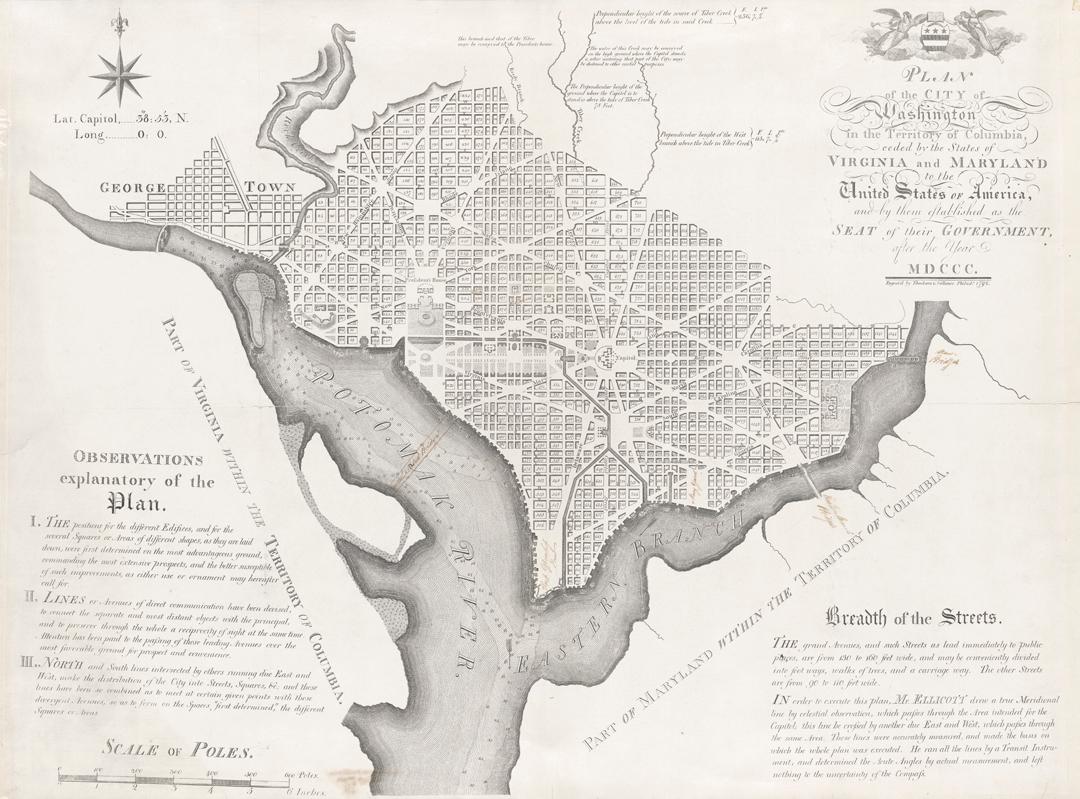
Plan of the city of Washington in the territory of Columbia 1792 – Courtesy Library of Congress
In 1791, Pierre Charles L’Enfant unveiled his ambitious plan for a new federal city along the Potomac River. He envisioned wide avenues, expansive vistas, and grand public spaces. His design for Washington, D.C., was never fully realized. Its monumental landscape developed incrementally – through pauses, revisions, debates, and renewed commitments. It included radiating avenues intersecting a straight-lined grid, converging on open spaces set aside for monuments not yet conceived.¹
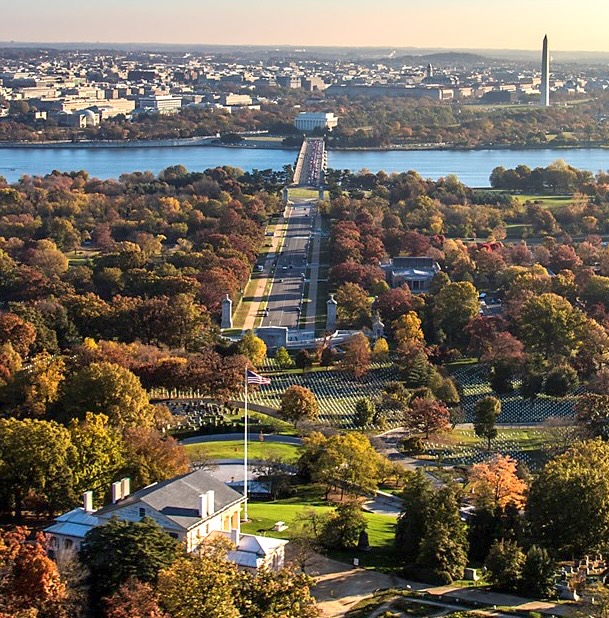
Arlington House line of sight to Arlington Memorial Bridge and Lincoln Memorial – National Park Service
Across the river was the heights of Arlington, Virginia, largely pastoral, interrupted by woods and farms. This changed in 1802 when George Washington Parke Custis began building Arlington House, a memorial to George Washington.² From its portico, the unfinished capital was visible – a city still more aspiration than reality. The evolving relationship between Washington and Arlington reflects the nation’s ongoing effort to define how it remembers its leaders, its conflicts, and its ideals.
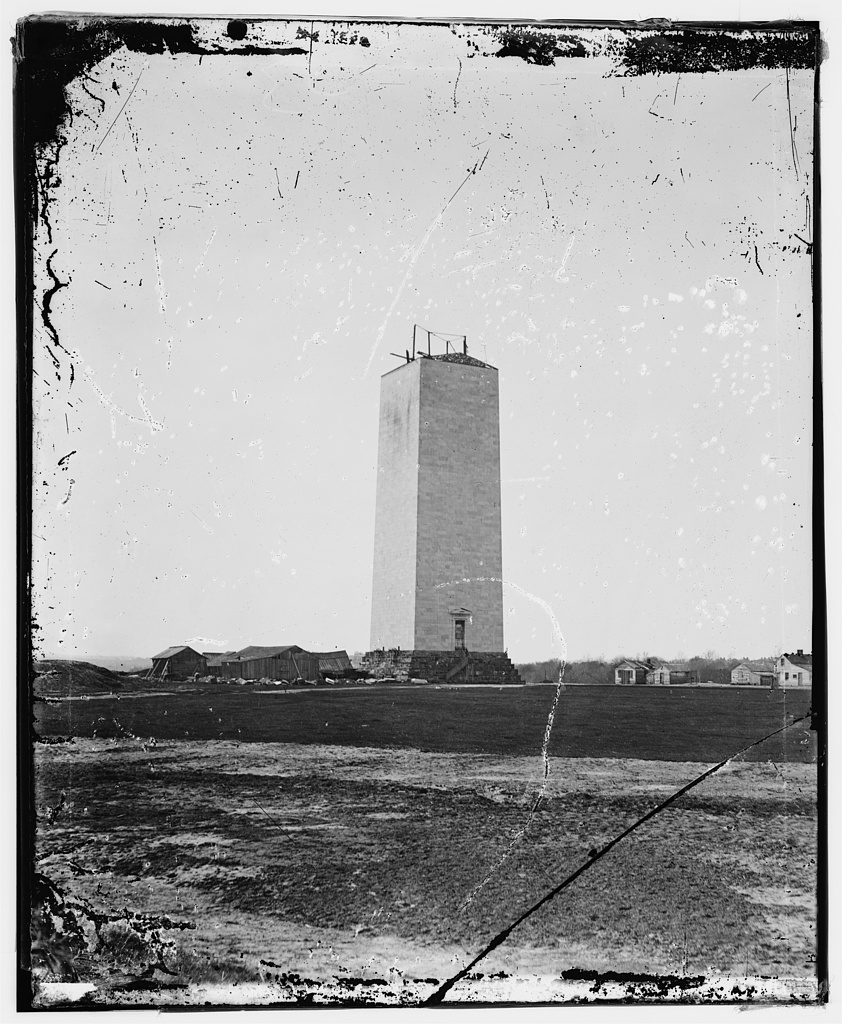
Unfinished Washington Monument circa 1860s – Courtesy Library of Congress
An early test of L’Enfant’s vision was the construction of the Washington Monument, which was started in 1848 as another tribute to the nation’s first president.³ Construction stalled amid political turmoil and a lack of funds, leaving the obelisk only partially complete by 1854.⁴ For years, the unfinished structure stood isolated in the landscape. Construction resumed after the Civil War, and the monument was completed in 1884, its visible color change marking the decades-long interruption.⁵
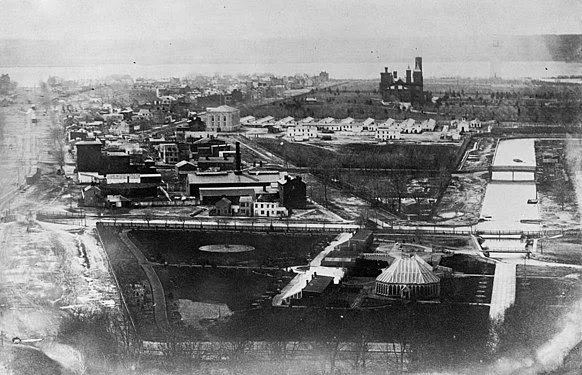
View from the Capitol circa 1860s – Courtesy Library of Congress
By the late 1800s, the area from the Capitol building to the Washington Monument had become overdeveloped, crowded with railroad tracks, greenhouses, and uneven landscaping.⁶ In 1901, the U.S. Senate Park Commission – better known as the McMillan Commission – was established to restore and complete L’Enfant’s 1791 plan.⁷
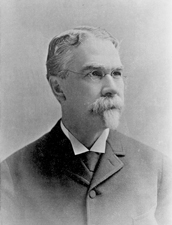
As chair of the Senate Committee on the District of Columbia, James McMillan spearheaded efforts to beautify the nation’s capital and revive Pierre L’Enfant’s vision for the city. U.S. Senate Historical Office
Led by Senator James McMillan and guided by architect Daniel Burnham, the commission aimed to return to L’Enfant’s original vision: a grand, orderly plan centered around long sightlines, open space, and monumental symmetry.
The McMillan Plan embraced the “City Beautiful” movement and Beaux-Arts design principles, which favored classical architecture inspired by ancient Greece and Rome.⁸ Drawing on Burnham’s experience at the 1893 World’s Columbian Exposition in Chicago, the plan emphasized white marble buildings, columns, domes, and a unified monumental scale.⁹ Federal buildings along the Mall were arranged to create a harmonious and dignified setting, reinforcing Washington’s identity as a capital grounded in democratic ideals.¹⁰
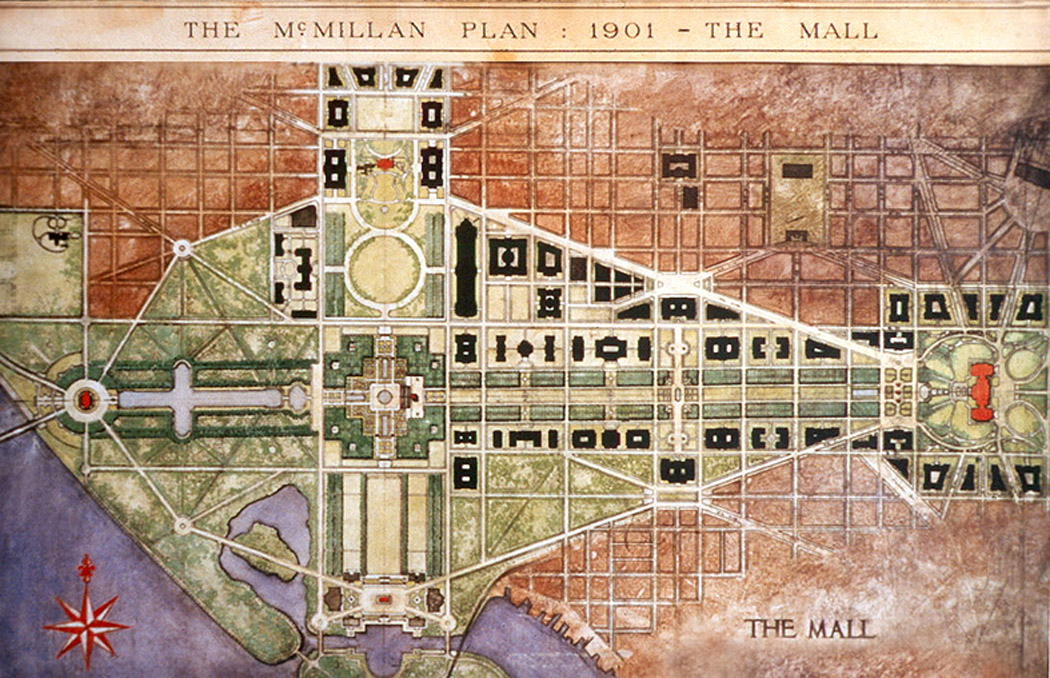
The McMillan Plan 1901. U.S. Senate Historical Office
The commission also proposed redesigning the National Mall’s landscape. Marshland was reclaimed to create a long, continuous lawn framed by museums and public institutions, ending in a major western memorial.¹¹ In 1914, construction began on the Lincoln Memorial at the western end of the Mall. Designed by architect Henry Bacon, the memorial was dedicated in 1922.¹² The alignment of the Lincoln Memorial later influenced the placement of the Arlington Memorial Bridge, completed in 1932.¹³ The bridge physically and symbolically connects Washington to Arlington National Cemetery and the Custis-Lee estate. It stands as a symbol of national reconciliation after the Civil War.
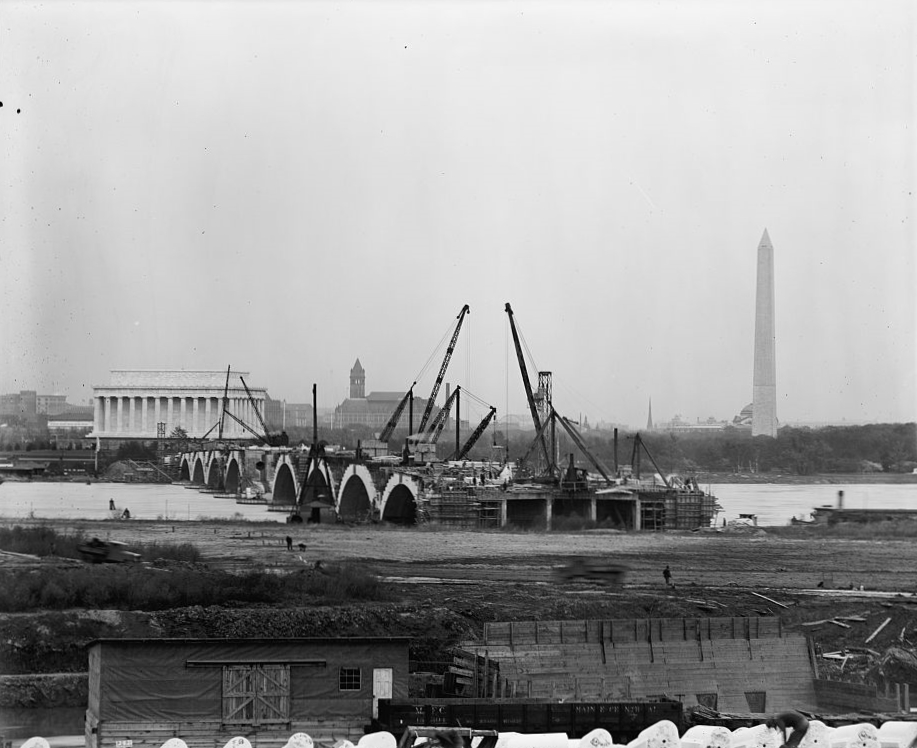
Arlington Memorial Bridge Under Construction – Library of Congress
Arlington Memorial Bridge became the new western anchor of the city’s monumental landscape. From the steps of the Lincoln Memorial, the view extends across the Potomac, through Memorial Circle, and up to Arlington Cemetery. A reciprocal view awaits visitors at Arlington House, looking back toward the capital.¹⁴ The bridge’s low profile and repeated arches preserve this visual corridor without overpowering the memorials at either end.¹⁵
The Jefferson Memorial was constructed between 1939 and 1943 beside the Tidal Basin and dedicated during World War II.¹⁶ In the late twentieth century, commemorative design evolved. The Vietnam Veterans Memorial, dedicated in 1982, introduced a minimalist form that emphasized individual names rather than heroic statuary.¹⁷ The Korean War Veterans Memorial, dedicated in 1995, incorporated sculptural figures and inscriptions to honor service members.¹⁸ In 1997, the Franklin Delano Roosevelt Memorial was constructed along the southwest side of the Tidal Basin. Unlike earlier presidential memorials, the FDR Memorial uses stone, water, and landscaping to tell the story of FDR’s presidency in a more accessible way.
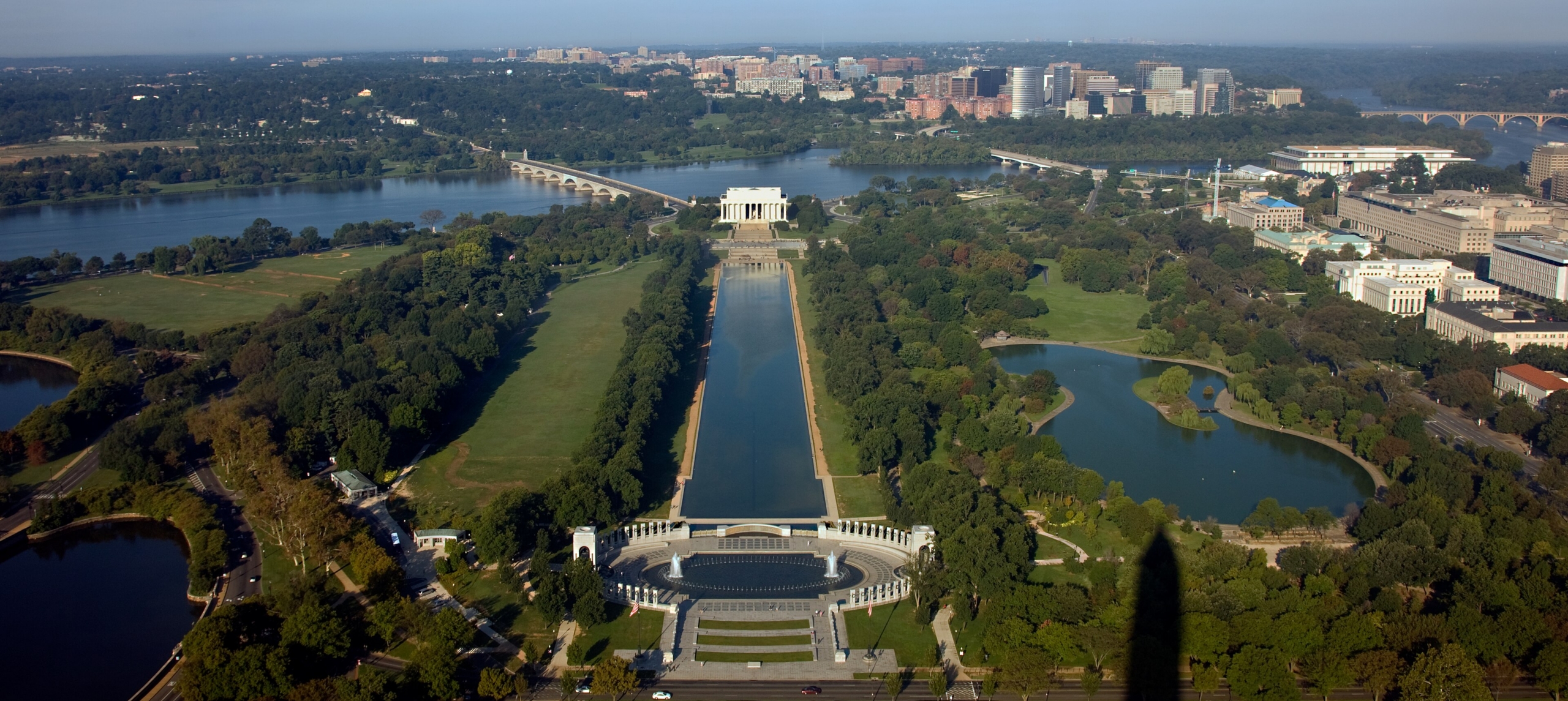
Aerial view from the Washington Monument looking towards Virginia, circa 2020 – National Park Service
Today, the McMillan Commission’s plan still serves as the guiding framework for the National Mall. Recent memorials—including the World War II Memorial, dedicated in 2004, and the Martin Luther King Jr. Memorial, dedicated in 2011—adhere to the axial layout and classical order that the commission restored.¹⁹ The Desert Shield and Desert Storm Memorial, located near the Lincoln and Vietnam Veterans’ Memorials, is the most recent monument under construction. It had its groundbreaking in 2022 and is expected to be completed in late 2026.²⁰ Under federal preservation standards, monumental structures are consistently evaluated based on “historic integrity,” which encompasses design, setting, feeling, and association.²¹
The growing number of monuments reflects the nation’s ongoing effort to define how it remembers its leaders, its conflicts, and its ideals. New proposals for the Mall are judged not only on their individual merits but also on their impact on established views and symbolic connections. By restoring L’Enfant’s vision, the McMillan Commission transformed the National Mall into a unified and symbolic public space – one that still requires careful stewardship today.
Endnotes
- Pierre Charles L’Enfant, Plan of the City Intended for the Permanent Seat of the Government of the United States (1791), Library of Congress, Geography and Map Division.
- Charles Moore, The Improvement of the Park System of the District of Columbia (Washington, DC: Government Printing Office, 1902), 23–25; National Park Service, “Arlington House, The Robert E. Lee Memorial: Historic Structure Report,” Washington, DC.
- John Steele Gordon, Washington’s Monument and the Fascinating History of the Obelisk (New York: Bloomsbury, 2016), 35–48.
- ibid, 83–95.
- ibid, 129–140.
- Moore, Improvement of the Park System, 38–41.
- U.S. Senate Park Commission (McMillan Commission), The Senate Park Commission Plan for the District of Columbia (Washington, DC: Government Printing Office, 1902).
- William H. Wilson, The City Beautiful Movement (Baltimore: Johns Hopkins University Press, 1989), 78–102.
- Daniel H. Burnham and Edward H. Bennett, Plan of Chicago (Chicago: Commercial Club, 1909), introduction; Wilson, City Beautiful Movement, 90–95.
- Moore, Improvement of the Park System, 55–60.
- ibid, 71–80.
- National Park Service, “Lincoln Memorial,” Washington, DC, accessed 2026.
- National Park Service, “Arlington Memorial Bridge,” Washington, DC, accessed 2026.
- ibid
- ibid
- National Park Service, “Thomas Jefferson Memorial,” Washington, DC, accessed 2026.
- Kristin Ann Hass, Carried to the Wall: American Memory and the Vietnam Veterans Memorial (Berkeley: University of California Press, 1998), 12–30.
- National Park Service, “Korean War Veterans Memorial,” Washington, DC, accessed 2026.
- National Park Service, “World War II Memorial”; National Park Service, “Martin Luther King, Jr. Memorial,” Washington, DC, accessed 2026.
- National Park Service, “Desert Storm and Desert Shield Memorial,” Washington, DC, accessed 2026.
- U.S. Department of the Interior, National Park Service, National Register Bulletin: How to Apply the National Register Criteria for Evaluation (Washington, DC: Government Printing Office, 1997), 44–46.

