
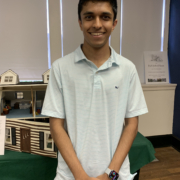
Sheel Shah/Arlington Tech graduate (Class of 2025) (in-person interview on July 14, 2025, at
Arlington Historical Museum)
[LIGHTLY EDITED FOR CLARITY/READABILITY]
Chris Park: Could you tell a little bit about yourself [and] your journey going to Arlington Tech?
SS: Sure. I started as, of course, a computer science nerd, and I was trying to figure out where
do I want to go? The options were Tech, my homeschool, which is Yorktown, and then the
possibility of TJ [Thomas Jefferson] High School. TJ High School was a little bit out of the
question because my year was when they changed the application process. So I got waitlisted,
but the real options were Arlington Tech and Yorktown. So at that time, I didn’t really know much
about Arlington Tech, because it was also the year of COVID, so I didn’t get a tour of it. So I kind
of like heard things about it, but I didn’t really know anything.
So I met with the computer science teacher, and I showed him some of the things I’ve done, and
I was like, “Look, in middle school, I was a little bit bored in some of my classes. I didn’t really
learn much. I just don’t want that to be the case in high school. I think high school is a very
important time.” And he agreed, and he said, “Look, if you come here, I’m not going to put you in
an intro class, right? And I’ll see what I can do. Maybe I can get you an internship.” So [it]
immediately jumped out [that] this guy who talked to me for maybe two minutes, and he was
already willing to get me an internship. So that he’s really the reason. He’s the computer science
teacher. He’s the reason I came here. His name’s Mr. Jeff Elkner. So, yeah, I think I came here
for the computer science program. I came there because of him.
And I realized that now looking back on it, I think I stayed for just about everything else. I think
we have a lot of different programs at our school that I obviously don’t have experience in all of
them, but we have like a great engineering program that I’ve taken some classes in. I did a
project for the Auto Collision Automotive Department. They have an amazing program as well.
So I think the main thing looking back on it at Arlington Tech, it’s literally like a college. Like they
have so many different things for you. Even there were people who didn’t really know what they
wanted to do, so that people dabbled in TV production and then they went to Skills USA and
won in States [competition]. And then there were people doing all kinds of things like wanting to
become a doctor or maybe not even going to college and working for Mercedes Benz [Service
Center] (there were some people who did that). So there’s a wide range, and that was kind of
what I noticed.
CP: That’s great. You just talked about, you know, the automotive collision project. I know you
worked on the whole electric car thing. what are some of your accomplishments there? Because
I know that was pretty big.
SS: Yeah, that was definitely one of them because I was able to win our school $10,000. So that
was definitely a huge one. But a lot of that I think I did a lot to kind of drive the computer science
department forward, and I did two things. One was more personal glory, which I’ll get into later.
But the second one was this year in January, we planned nine months prior to host a coding
competition, and we did so. Over 50 people came. It was for middle school and high school
students. We had a division for each. And it helped to kind of draw attention to Arlington Tech
because I know Dr. [Michelle] Van Lare is doing a good job now of advertising and making sure
people actually know what Arlington Tech is. But there’s not as much of a focus on computer
science. There’s much more of a focus on engineering, on project-based learning. But the
computer science department, it’s kind of tucked away in the second trailer, like nobody really
knows what’s going on or what they’re learning. So it was great to kind of shine a light on it. And
I was really pleased with what I saw from the talent of the middle school students, because they
were so good at all of the middle school problems, they just finished in half the time they were
supposed to. So then we gave them the high school problems, and some of them started doing
better than the high school teams. So that really gives me hope for the future, if even only one
or two of them want to come, I think that’s still huge. And it was a great event. And the parents
were happy, students were happy. I think everyone was really happy with that. So that was the
one that I did for everyone else at Arlington Tech.
And then the one I did for personal glory, actually, Mr. Elkner. I get a call. It starts before the last
week of summer before sophomore year, I get a call on my mom’s phone and it’s him. So then
he gives it to me. He’s like, “Hi, I know this guy in Texas A&M. He’s doing his doctoral research,
and he’s a marine biologist, so he doesn’t know anything about technology, but he needs
someone to help him with computer vision, like machine learning and AI.” So I was like, “Yeah,
sure, I’d love to.” So we worked on it for a couple months and then later that next year, his
research got published, and I was listed as a co-author on it. So technically, I have a published
paper. It was an amazing experience. And it’s great working with people who don’t have the
same skill set as you, right? Because in the real world, you’re not only going to be working with,
if you’re a doctor, you’re not going to be working with other doctors. You’re going to be working
with patients who didn’t go to med school. And the same thing in computer science. You’re
going to be working with people who may not know technology. So when he came to me doing
research, he didn’t even know if it was possible. But with some of the skills that I learned from
Arlington Tech, I think I was able to do something pretty cool.
CP: That’s great.. Yeah, what I’m hearing is that Arlington Tech has done a pretty good job
preparing you for future careers, college, that type of stuff.
SS: Yeah, that’s definitely true. You learn all the types of things, and even like senior year, they
have Capstone. So pretty much everyone gets an internship through the school. They’re able to
get an internship. So that’s about as real-world as you can get, I think. And there are, again,
people doing all kinds of things. Some people are working as TAs because they want to do
something like super specific that that maybe a job can’t really get you, but then there are
people like I personally worked at a subcontractor of General Dynamics, their IT department,
Stratus. So I did database work. So, sometimes they’re like more formal jobs. There was
someone who even, I think, worked as a physical therapist. So they’re doing physical therapy.
So, really the best way to get your hands on real-world experience and also probably helped a
lot of people at college applications as well.
CP: Definitely. I feel like, based on what I’ve seen in Arlington Tech, a lot of the hands-on
learning focus kind of expands to like you said careers, internships and everything like that.
Could you, I know you touched a little bit on, like the EV project raising $10,000 for the school.
Could you tell me a little more about that?
SS: Yeah. So I’d say, like a few months into senior year, the PBL–we have a project-based
learning coordinator, Dr. Thomas–she came to me and she’s like, “We’re doing this project with
an electric car and we need someone who knows computer science.” And I was like, “Yeah, I’d
love to.” So what the project was, our focus was trying to get an electric car to be controlled by a
computer.. And that’s a big thing, because the eventual goal is self-driving, but that’s going to
take a really long time. So our goal for this year was to get it to move forward and backward
without literally having our foot pressing the accelerator. So I worked with some of the people in
automotive classes who literally worked on the cars and knew what they were talking about,
worked with electrical engineers and other computer science students.
And it was maybe one of the most difficult things I’ve done just because, well, I guess multiple
reasons. One is, I don’t know anything about cars. But two, it’s difficult to work in that kind of
environment where people are doing different things. And initially, when the project, we
struggled. Mr. [Wilmer] Castro, who’s the automotive teacher, he was out because he had
surgery. So then we didn’t have a real leader. So then I stepped up; I was, I guess, the leader in
that project. And then eventually, we hit the ball, we got rolling, and we got the computer to
drive, by being controlled by a computer through an electrical voltage that we sent in the motor.
After that, I feel like we just kept getting lucky. We took it to a Wakefield car show. We won Best
in Show. There were some really nice cars there. There was a V8 Jaguar; that was really cool.
There were some really, really nice cars there. And then, yeah, of course, we won the
competition, which gives $10,000. So that was huge.
And what’s very nice now is now colleges are starting to turn their heads. Mr. Castro told me
Virginia Tech’s interested. So maybe this summer, they come tour. He was going to try and
figure out there’s this big car show in Vegas. If we could figure out how to get it there…that may
not happen. But we’ll see. So it started as this tiny little opportunity to say, “Hey, let’s get a
computer to control the motor.” And now it’s become this massive networking event, because
even at the Wakefield Car Show, I’ve met the director of NoVA [Northern Virginia Community
College], who is the director of their automotive program. So I met all kinds of people, and if I
meet the people at Virginia Tech, I’ll learn even more, even more people. And I really learned a
lot about cars, even still about computer science. So it was an amazing opportunity.
CP: Yeah, that’s really nice. You touched on colleges becoming a little more interested in…they
were turning their heads to Arlington Tech, like the project there. What do you hope for the
future of Arlington Tech, not only in the college landscape but in the curriculum and community?
SS: Yeah, I’m starting to be a big critic of traditional education. And I think part of the reason is
because now we’re starting to learn that the best way to teach someone is not to throw a
textbook at them and say, “Chapter 15, go ahead.” So I think the best way you can learn is really
by building skills, right? If you want to learn about a car engine, you could give someone a
diagram and say, “This is what it looks like,” and they might learn. Or you can show them a car,
open the hood, and say, “This is an engine”; maybe we can take it apart and explain each piece
and show how it works together, why the pieces are shaped a certain way. And I’m really hoping
that Arlington Tech–it’s harder in the traditional classes, like history and stuff to do that type of
thing–but especially in the electives, I’m hoping that they maintain their focus of building skills
instead of building, like telling them, “Hey, this is the curriculum, this is a syllabus, this is what
we’re going to learn.” Having it more open-ended, almost like an open curriculum, which sounds
a little weird to say, but, yeah. And I want Al and Tech to be kind of a place for everyone, which it
is now and I want it to stay that way. There are some people who are like, “I want to go to the
best college in the world. I want to go to Harvard or the Ivies or whatever.” And then there are
some people on the complete other end who are like, “I don’t know if I can afford college, may
not be in the cards for me.” But I think it’s so important to have all of that, that big spectrum. And
I will say I’ve learned a lot from other people that in ways that I didn’t even expect to. and so
much to the point where the person I was four years ago, I wouldn’t remember him just because
of how much I’ve learned. It’s really nice.
CP: In terms of misconceptions that other people have about Arlington Tech, especially the
openness and their curriculum [being] more hands-on, like project-based focus rather than a
traditional curriculum. I know you said that worked for you and a lot of the other kids there. But
from an outsider’s perspective, what do you think are some issues that other people have?
SS: I think the main issue is it’s a new school, so people are still like, “Do I want to go here?”
And that was the same thing for my parents and I thinking, “What really is this school about?”
But people that I’ve talked to, even some of my friends who go to Yorktown or wherever, they
don’t really know anything about Arlington Tech, like what it has to offer. And some of the people
are coming out of Yorktown [or] wherever studying mechanical engineering, and in my head I’m
thinking, “Why didn’t you come to Arlington Tech?” Maybe not come full-time, but you’re allowed
to bus over and take a class. And I think they would have learned a lot. So I think the biggest
misconception is it seems impractical. They truly don’t know what it’s like at all. Tthere was even
someone who bussed over and I was like, “Oh, you come to Arlington Tech part-time.” I’m about
to head to history. And he’s like, “Wait, wait, you can go here full time?” So, some of that is, I
guess, just unlucky, them not paying attention. But people truthfully don’t know what it is.
One thing I think is important to note is we don’t offer any AP classes, which might be scary to
some people for college placement. But we offer instead classes at the local community college,
NoVA. And they’re transferable to pretty much anywhere in the state. Some colleges are a little
bit snobby about transfers. But even out of state, they transfer [credits]; I’m going to the
University of Maryland. A lot of them are going to transfer. So it’s really the AP classes, I think, is
one main distinction. Obviously, project-based learning is another big distinction. In an AP class,
you’re very much bound by a curriculum because you got to take the AP test at the end of the
year. And there can be some bad luck, right? Because you only get the credit if you do well on
the exam. So someone wakes up sick one morning or, you know, whatever they hit their head
and they have a concussion, they still have to take the AP exam. But dual enrollment [at NoVA],
you just have to get a good grade in the class overall, like a passing grade. And then you get
college credit. And because it’s not bound by a set curriculum, one of the things the teachers
can do is allow for more project-based learning, of course. But then also they can dive into
certain topics that otherwise AP classes won’t and they can leave things out that they don’t think
are as important. Like, I was comparing my dual enrollment biology class to the AP biology
classes, and I noticed there were certain things we learned where they’re not in the AP exam.
But then there are certain things in the AP exam that looked kind of irrelevant that we left out.
And I think that’s very important. I think it’s great that some of the teachers get to design their
own curriculum to custom-fit what the students need.
CP: Thank you, Sheel. Is there anything else you want to add before we wrap up here?
SS: I guess if there are people who are hearing this that maybe don’t know if Arlington Tech is
for them, there’s this: because it’s called Arlington Tech, people think it’s a tech school, and a
little bit we are. But there are people who are doing things that are not at all related to tech.
There are people who are doing photography, and then they had their photos on display and
even sold some of them. There were people, like I said, wanted to become physical therapists,
doctors, and got certified. There were people who were doing Photoshop, TV production. So a
lot of the classes we have certifications; culinary is another one. And they had certifications. So
when I truly, I keep saying this, but there’s truly something for everyone, like a college. And
there are all sorts of things for all sorts of different people. And if you don’t know what you want
to do, there are plenty of options for you to try and see what you like, and maybe you’ll end up
really liking what you have.
Share this post

