
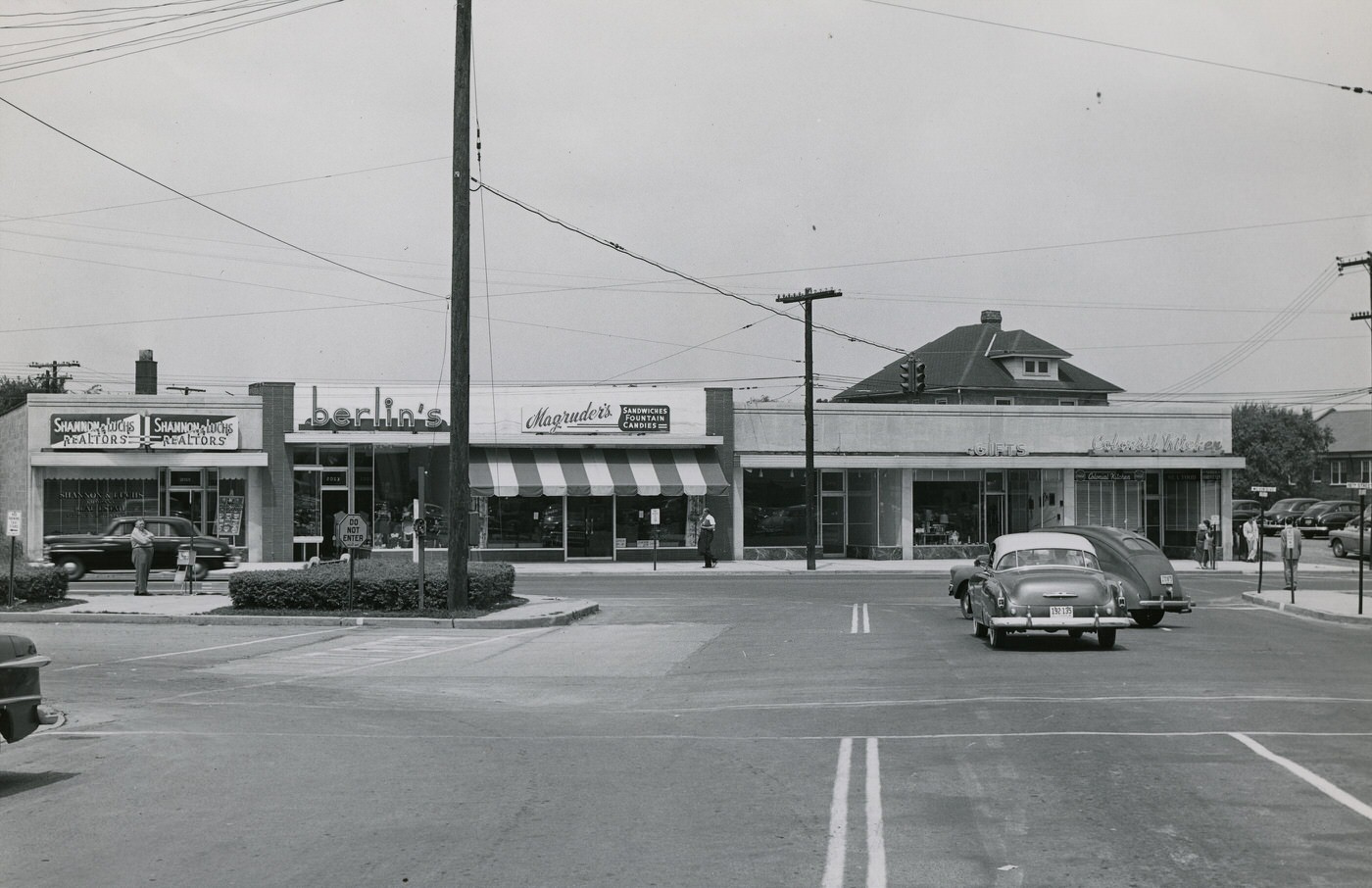
Front view of the Four Courts Post Office block at the intersection of Wilson Boulevard and Courthouse Road, 1952.
Life in Arlington, Virginia, and the United States in 1956
A Community on the Edge of Transformation
The year 1956 was one of optimism, prosperity, and profound change. Americans celebrated a booming economy, expanding suburbs, and new technologies that promised a better future. Yet beneath the confidence of the postwar era were growing tensions over civil rights, the Cold War, and the rapid transformation of communities across the nation. Few places reflected these changes more clearly than Arlington, Virginia.
Located just across the Potomac River from Washington, D.C., Arlington stood at the crossroads of old and new. Once a rural county of farms and villages, it had become one of America’s fastest-growing suburban communities. New neighborhoods, shopping centers, schools, and highways reshaped the landscape, while longtime residents watched familiar landmarks disappear. It was against this backdrop that a group of concerned citizens founded the Arlington Historical Society in September 1956 to preserve the county’s rapidly vanishing history.
America in 1956
The United States was enjoying one of the strongest economies in its history. President Dwight D. Eisenhower was seeking reelection, promising continued peace and prosperity after leading the nation through much of the early Cold War. The average annual household income was approximately $4,800, and unemployment remained low. New consumer goods—including televisions, washing machines, and automobiles—were becoming commonplace in American homes.
Television had become the nation’s favorite form of entertainment. Families gathered around black-and-white sets to watch I Love Lucy, The Ed Sullivan Show, and Gunsmoke. Elvis Presley burst onto the national stage with “Heartbreak Hotel” and his appearances on national television, helping define a new youth culture.
The Interstate Highway Act, signed by President Eisenhower in June 1956, launched the largest public works project in American history. The new highway system would eventually reshape travel, commerce, and suburban development throughout the country, including Northern Virginia.
Yet 1956 was also a year of significant social change. Two years after the Supreme Court’s decision in Brown v. Board of Education, communities across the South wrestled with school desegregation. The Montgomery Bus Boycott, led by Martin Luther King Jr., continued to inspire the emerging Civil Rights Movement. Internationally, Americans followed the Suez Crisis and the Hungarian Revolution, reminders that Cold War tensions remained high.
Arlington in 1956
Arlington County was changing at an extraordinary pace. During World War II and the decade that followed, thousands of federal employees and military families settled in Northern Virginia. By the mid-1950s, Arlington had grown from a largely rural county into a thriving suburban community of more than 150,000 residents.
Construction cranes dotted the skyline. Former farms gave way to subdivisions, apartment buildings, office complexes, and shopping centers. New schools opened to accommodate growing enrollment, while improvements to roads and public infrastructure attempted to keep pace with the county’s expanding population.
Neighborhoods such as Lyon Village, Cherrydale, and Aurora Highlands had matured into established communities, while newer developments continued to spread westward. The opening of Parkington Shopping Center (today’s Ballston Quarter) earlier in the decade symbolized Arlington’s emergence as a modern suburban retail destination.
Automobiles dominated daily life. Families increasingly relied on cars for work, shopping, and recreation. Wilson Boulevard, Lee Highway, Columbia Pike, and Arlington Boulevard became major transportation corridors connecting Arlington with Washington and the surrounding suburbs.
Everyday Life
For many Arlington residents, life centered on family, work, church, and school.
Children walked to neighborhood elementary schools, played baseball in local parks, and rode bicycles through quiet residential streets. Scout troops, Little League teams, and civic clubs flourished.
Most households owned one automobile, although many families were purchasing a second car as suburban life expanded. The average price of a new home in the United States was about $11,700, making homeownership attainable for many middle-class families. A gallon of gasoline cost about 30 cents, and a loaf of bread about 18 cents.
Shopping was changing rapidly. Traditional downtown business districts increasingly competed with modern shopping centers offering free parking and a variety of stores in one location.
Arlington and the Federal Government
Arlington’s economy remained closely tied to the federal government. Thousands of residents worked in Washington at the Pentagon, federal agencies, or military installations. The Pentagon, only fifteen years old in 1956, had permanently transformed Arlington into one of the nation’s most important centers of government and defense.
Federal employment brought economic stability but also fueled residential growth. New apartment buildings and subdivisions appeared to accommodate government workers, while commercial development expanded to serve the growing population.
Preserving a Vanishing Past
Not everyone viewed Arlington’s rapid development with enthusiasm.
Historic homes, farms, mills, and crossroads communities were disappearing almost as quickly as they could be documented. Roads were widened, neighborhoods redeveloped, and agricultural landscapes replaced by subdivisions. Many residents worried that Arlington’s rich history—from colonial plantations to Civil War landmarks—might be lost forever.
Those concerns inspired local historians, preservationists, and civic leaders to organize the Arlington Historical Society. Following informal discussions at The Glebe, the home of State Senator Frank L. Ball Sr. and his wife, the Society officially organized on September 14, 1956, at the home of Laszlo Ecker-Racz and Cornelia B. Rose Jr.
The Society’s founders recognized that Arlington stood at a pivotal moment. If its history was not collected, documented, and preserved immediately, much of it would disappear beneath new development.
Looking Back
Today, it is easy to see 1956 as the beginning of modern Arlington. The county’s skyline, neighborhoods, transportation network, and economy were all being reshaped during that remarkable year. At the same time, dedicated citizens understood that progress should not come at the expense of memory.
Seventy years later, many of the places that defined Arlington in 1956 have changed beyond recognition. Yet the work begun by the Arlington Historical Society continues to ensure that the stories of earlier generations remain part of the county’s identity. Understanding life in Arlington during 1956 reminds us that today’s community was built upon decades of growth, adaptation, and an enduring commitment to preserving its unique past.
Sources
- U.S. Census Bureau, 1950 Census of Population and historical population estimates.
- Dwight D. Eisenhower Presidential Library, “Federal-Aid Highway Act of 1956.”
- National Park Service, Arlington House, The Robert E. Lee Memorial.
- Library of Congress, America at Mid-Century collections.
- Arlington County Government, Historic Preservation Program.
- Arlington Historical Society archives and organizational records, 1956.
- Virginia Department of Historic Resources, Historic Resources of Arlington County.

