
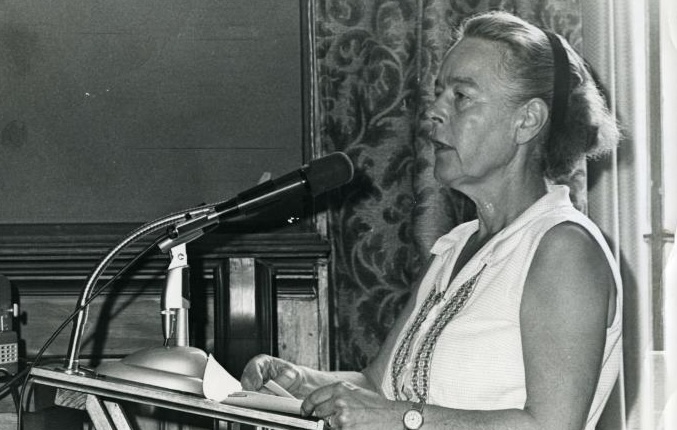
 Cornelia B. (“C.B.”) Rose and the Creation of the Arlington Historical Society
When the history of the Arlington Historical Society (AHS) is told, familiar names such as Frank L. Ball, Eleanor Lee Templeman, C. Harrison Mann, and Robert Nelson Anderson are rightly recognized as founders of the organization. Equally deserving of recognition is Cornelia Bruère (“C.B.”) Rose, Jr., whose scholarship, organizational leadership, and decades of service helped transform a fledgling historical society into Arlington County’s leading institution for local history.
Although she did not seek the spotlight, Rose was one of the Society’s indispensable architects. Her work extended far beyond its founding in 1956. As researcher, author, officer, president, editor, and historian, she helped establish the standards of historical research that continue to define the Arlington Historical Society today.
A Growing County in Need of Its History
By the mid-1950s, Arlington County was changing rapidly. Once a largely rural community of farms and villages, Arlington had become one of the nation’s fastest-growing suburban counties. Residential subdivisions, highways, schools, and commercial centers were transforming the landscape at an unprecedented pace. Historic homes were disappearing, longtime residents were moving away, and valuable records and artifacts were being lost.
A small group of county officials, historians, civic leaders, and preservation advocates recognized that unless someone acted quickly, much of Arlington’s history would vanish.
Among those who shared this concern was Cornelia B. Rose, a research assistant in the Arlington County Manager’s Office. Her professional work required extensive research into county government, planning, land records, and public policy. This experience gave her an unusually deep understanding of Arlington’s historical development and the importance of preserving documentary evidence.
The Founding of the Society
The first conversations about establishing an Arlington historical society grew out of informal discussions among county officials and local historians. According to Eleanor Lee Templeman’s 1976 history of the Society, these early discussions led former Virginia State Senator Frank L. Ball to invite interested citizens to his historic home, the Glebe House, to consider creating a county historical society.
Following that initial gathering, an organizational meeting was held on September 14, 1956, at the home of Laszlo Ecker-Racz and Cornelia B. Rose. This meeting formally organized the Arlington Historical Society and elected its first officers:
- C. Harrison Mann, Jr., President
- Frank L. Ball, Vice President
- Robert Nelson Anderson, Secretary
- Cornelia B. Rose, Treasurer
- Ashton C. Jones, Sr., Executive Committee
Robert Nelson Anderson was also appointed to draft the Society’s constitution. Two months later, the Society held its first county-wide public meeting at Arlington House (then known as the Custis-Lee Mansion), attracting widespread public interest.
Hosting the organizational meeting in her own home reflected Rose’s central role in transforming the idea of a historical society into a functioning organization.
Building the Society
Founding an organization required far more than electing officers. The Society needed members, finances, publications, programs, and credibility.
Rose became one of the individuals who supplied all of these.
As the Society’s first treasurer, she helped establish its administrative foundation. During the Society’s early years she also participated in collecting documents, encouraging membership, organizing meetings, and helping define the Society’s mission.
Unlike many local historical organizations that concentrated primarily on preserving artifacts, the Arlington Historical Society emphasized original research and publication from its earliest days. Rose became one of the principal architects of this scholarly tradition.
A Prolific Historian
Beginning with the inaugural issue of the Arlington Historical Magazine in 1957, Rose became one of its most productive contributors.
Over the next two decades she authored articles on subjects including:
- Arlington’s changing political boundaries
- Colonial settlement
- Civil War forts
- Public education
- Annexation
- Early maps
- Elections and government
- Roads and transportation
- Agricultural history
- Arlington families
- Local finance
- Historic geography
Her articles were distinguished by careful documentation and extensive use of primary sources. Many remain valuable references for researchers today.
Arlington County, Virginia: A History
Rose’s greatest scholarly achievement came in 1976 with the publication of Arlington County, Virginia: A History, the first comprehensive history of the county published by the Arlington Historical Society.
Drawing upon decades of archival research, county records, newspapers, maps, and original documents, the volume traced Arlington’s development from Native American settlement through the twentieth century.
Nearly fifty years later, historians continue to regard it as one of the foundational works on Arlington history. The Arlington Historical Society still describes it as the best comprehensive history of Arlington through the mid-1970s.
Leadership Beyond Scholarship
Rose’s contributions were not limited to writing.
She later served as president of the Arlington Historical Society, guiding the organization during a period of growth in membership, publications, and public programming. Under the leadership of Rose and her fellow founders, the Society expanded its educational mission while strengthening its reputation for rigorous historical research.
Her professional experience within Arlington County government also allowed her to connect local history with planning, preservation, and public policy. She understood that preserving history required both scholarship and civic engagement.
Creating a Historical Legacy
The Society founded in 1956 became far more than a discussion group.
Today it maintains historic properties, preserves collections, publishes the Arlington Historical Magazine, sponsors lectures and educational programs, conducts historical research, and promotes preservation throughout Arlington County. The organization remains guided by many of the same objectives adopted at its founding: the discovery, preservation, restoration, and dissemination of Arlington’s history.
Those accomplishments owe much to Rose’s quiet but sustained leadership.
Remembering Cornelia B. Rose
History often remembers founders through a single meeting or a ceremonial title. Cornelia B. Rose’s importance lies in something deeper.
She helped organize the Society at its birth.
She provided one of its earliest meeting places.
She served among its first officers.
She wrote many of its earliest scholarly articles.
She later led the organization as president.
Finally, she produced the county’s first comprehensive history—a work that continues to inform historians nearly half a century later.
In many respects, Cornelia B. Rose gave the Arlington Historical Society its scholarly voice. While others helped create the institution, Rose helped define its purpose: preserving Arlington’s past through careful research, thoughtful interpretation, and the publication of reliable local history.
As the Arlington Historical Society celebrates its seventieth anniversary, Cornelia B. Rose deserves recognition not only as one of its founders, but as one of the individuals most responsible for shaping its enduring legacy.
Selected Sources
- Ruth Preston Rose, “Fifty Years of the Arlington Historical Society,” Arlington Historical Magazine, Vol. 17, No. 3 (2006).
- Eleanor Lee Templeman, “A Biography of the Arlington Historical Society,” Arlington Historical Magazine, Vol. 5, No. 4 (1976).
- Arlington Historical Magazine archive, Arlington Historical Society.
- Arlington County, Virginia: A History, Cornelia B. Rose, Jr. (Arlington Historical Society, 1976).
- Arlington Historical Society, “About.”

