
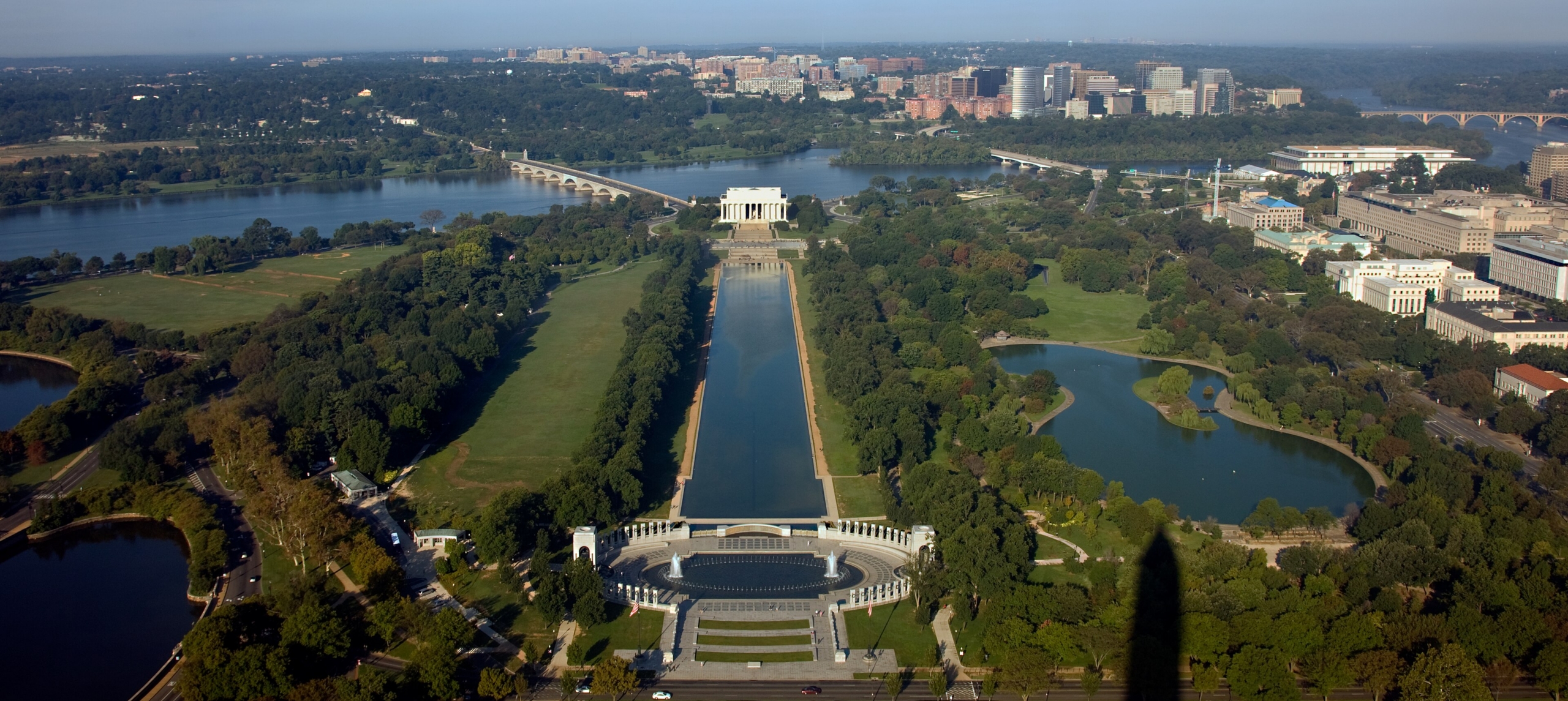
Aerial view from the Washington Monument looking towards Virginia, circa 2020 – National Park Service
Arlington residents are being asked to consider a proposal for a monumental arch near some of the nation’s most significant historic landmarks. While opinions on the proposal vary, most agree that a project of this scale deserves an open and transparent review process that allows the public to understand the facts and share their perspectives.
The Arlington Historical Society supports a careful evaluation of the proposal through established federal, state, and local review processes, including consideration by preservation, planning, and environmental authorities. Such a review would be undertaken by the Commission on Fine Arts and the National Capital Planning Commission and would include environmental review under the National Environmental Policy Act and historic preservation review under Section 106 of the National Historic Preservation Act. These reviews will help ensure that changes affecting nationally significant historic places are informed by expert analysis and public input.
The area surrounding Arlington House, Arlington National Cemetery, Arlington Memorial Bridge, and the Lincoln Memorial forms one of the most important historic landscapes in the United States. Completed in the early twentieth century, Arlington Memorial Bridge was designed as a symbol of national reconciliation following the Civil War. Linking the National Mall with Arlington National Cemetery, it serves as both a transportation corridor and a memorial to unity, remembrance, and shared sacrifice.
The bridge’s open views and carefully planned sightlines are integral parts of its historic design. Together with Arlington House and the surrounding memorial landscape, they create a setting experienced by millions of visitors each year. These visual connections help tell an important chapter of our nation’s story and have long been recognized as worthy of preservation. The historic line of sight, which also includes the Capitol and the Washington Monument, was influenced by the 1901 U.S. Senate Park Commission, better known as the McMillan Commission. Led by Senator James McMillan and guided by architect Daniel Burnham, the commission aimed to return to Pierre L’Enfant’s original vision: a grand, orderly plan centered around long sightlines, open space, and monumental symmetry.
Questions about views, sightlines, and the setting of historic landmarks are not new. Preservation professionals, planners, and courts have long recognized that the surroundings of historic places often contribute as much to their significance as the structures themselves. Nearly fifty years ago, the federal government sued Arlington County to limit building heights in Rosslyn (United States v. County Board of Arlington County). They argued that tall structures could adversely affect the visual experience of the nation’s monuments and memorials. While the court did not block the construction of these buildings, the case remains an important example of the longstanding public interest in preserving the historic character and integrity of the National Capital Region.
The Arlington Historical Society believes that any change to one of the nation’s most historically significant lines of sight should be evaluated through a thorough and open public process. A process that considers historic preservation, visual impacts, planning principles, and public input before decisions are made. The history of Washington and Arlington demonstrates that major alterations to the monumental landscape have traditionally been preceded by careful study and public debate.
References
Arlington Historical Society, “Restoring the Capital Vision,” accessed June 15, 2026, https://arlhist.org/restoring-the-capital-vision/.
Lynton, Stephen J. “A Long Road: Bitter Fight Against I-66 Now History.” The Washington Post, December 21, 1982.
Perry, Nancy. “How Eminent Domain Destroyed an Arlington Community.” Arlington Historical Magazine, 2017.
United States v. County Board of Arlington County, 487 F. Supp. 137 (E.D. Va. 1979).

