
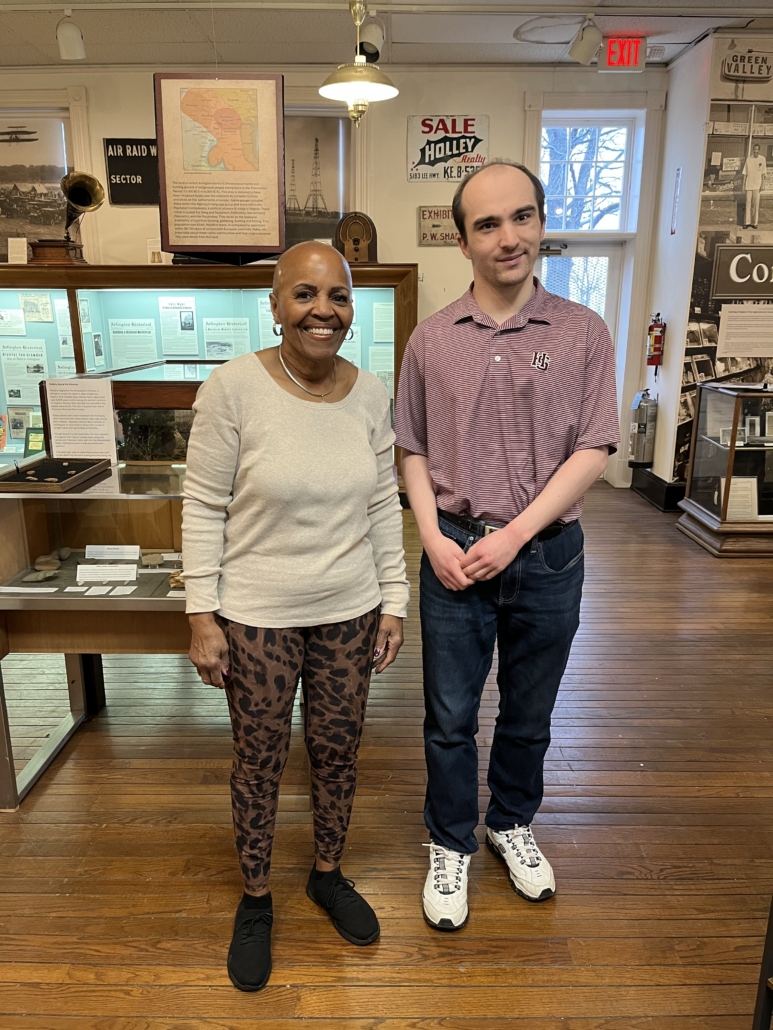
Sharon Monde
This document presents a transcript of the oral history interview by Seth Black with Sharon Brown Monde, a former student, educator and administrator of the Arlington School system.
Sharon Brown Monde: Okay. My name is Sharon Brown Monde. I am a native Arlingtonian. I attended Langston Elementary School, Swanson Middle School, and Washington Liberty, formerly Washington-Lee High School.
Interviewer: Mhmm.
Sharon Brown Monde: I still attend church in Arlington, Callaway United Methodist Church, and I’ve been there my entire life. My family has a home in Arlington. We still have a family home in Arlington where we have relatives living, and I’m glad to be here today.
Interviewer: Oh, good. And we’re glad to have you.
Sharon Brown Monde: Thank you.
Interviewer: Okay. So first question is, which schools did you attend as a student in Arlington, and which did you work at as a teacher and administrator?
Sharon Brown Monde: Okay. As stated previously, I attended Langston Elementary School, Swanson. It was Swanson Junior High School at the time, and then Washington-Lee High School. I went on to Bennett College in Greensboro, North Carolina, where I studied French and Spanish, and from there I went to the University of Rochester, where I became a linguist. I got my degree in Romance linguistics. And I’ll go back to one of the questions, but my interest in languages happened when I was in middle school. I had a very wonderful French teacher who encouraged me, and that’s how I decided that I was going to study French for the rest of my educational time.
Sharon Brown Monde: Upon graduating from the University of Rochester, I came back to Arlington. As I said, I got my master’s in linguistics. I came back to Arlington and was offered a teaching position, a French teaching position, at Woodlawn. It was Woodlawn Junior High School at the time, which is on South 16th Street. It’s currently where the hospice is located.
Sharon Brown Monde: And from there, because Arlington didn’t have a full-time job, I taught French at a couple of schools. When things finally settled in, I became a French and Spanish teacher in Arlington, teaching at probably every middle school, because that was my interest in Arlington. Then I decided that I wanted to work a little closer with students, work with discipline, see how students were doing, so I went into administration. I retired from Thomas Jefferson Middle School as the principal. And before my leaving, we were able to institute the International Baccalaureate program.
Sharon Brown Monde: We’re the only International Baccalaureate Middle Years Program in Arlington. So our students, our elementary students, came from Randolph, which was an elementary baccalaureate program, and they transitioned into Jefferson, which was the Middle Years Program. And then they transitioned, hopefully, into the first International Baccalaureate program, which was at Washington-Lee at the time, currently Washington-Liberty.
Interviewer: Okay. So what was your experience attending an all-Black school and then transitioning to an integrated one? What was the initial process like?
Sharon Brown Monde: Okay. Well, prior to my making that transition, there were four students who attended Stratford Junior High School, and they were the four students who actually laid the ground for the rest of us to go on to the other schools. My experience at Langston was wonderful. We had excellent teachers. We had a sense of community. We had folks who not only were our teachers but attended our church. And so everybody knew everybody. The parents, the teachers knew the parents. They could call the parents. And if things weren’t going right, they could call right away. But it was just a great experience. It was a solid education. The only difference was that we didn’t have all of the resources that the white schools had. And that can be important too. You’ve got to balance the resources with laying that foundation. So I attended Swanson, not Stratford, because of the way the lines were drawn.
Interviewer: Yeah.
Sharon Brown Monde: But making that transition, I didn’t think it was a bad thing. I mean, I think there was some work done to get both groups ready.
Interviewer: Mhmm.
Sharon Brown Monde: But, you know, it took some time. And as a result of taking that time and going through the educational system in Arlington, I still have some friends that I met when I was at Swanson. So it was a balancing kind of situation, making sure that not only did we represent our community, that’s the Black community, well, but also making sure that we let the other school understand that we were as smart as they were. We had been as educated as they were, even though our resources weren’t like theirs. We kind of had the secondhand textbooks and that kind of thing. But, in the end, it all worked out.
Interviewer: You kind of answered this, but could you elaborate more on-well, did you notice any difference in the school resources available to you when schools were integrated?
Sharon Brown Monde: Mhmm. Well, as I said, I went from elementary to middle school, and the textbooks were nicer. The technology-and I’m putting that in quotes, because back then technology was limited-but you had the technology there. We did not have any technology in the elementary school. And I’m not sure back then the other schools did either, because I did not go to a white elementary school. I had no interaction with a white elementary school. But I can remember distinctly in my French class, the headphones and those kinds of things. I could hear myself in that. So I think with the resources, we had the foundational resources, the textbooks, we had the chalkboards, those kinds of things. We were taught to speak in a way that made it sound like our thoughts were flowing. And by that I mean you didn’t say ‘you know’ in the middle. You just kept it going. Think about what you want to say and keep it going. And that’s a great resource to have. We practiced that. So that was what I would say as far as the resources.
Interviewer: Mhmm. Okay. Yep. So next question is, how has the makeup of the student body in Arlington changed from the time you were a student to when you became an administrator? Did you notice the student demographics changing during your time as a student?
Sharon Brown Monde: Okay. As a student or as an administrator?
Interviewer: I think it’s actually sort of both. Like, you’re-
Sharon Brown Monde: Okay.
Interviewer: Between the difference between sort of just over time-
Sharon Brown Monde: Okay.
Interviewer: But when schools started integrating, did you notice a change in demographics over the years?
Sharon Brown Monde: Yes. Mhmm. Yes. As a student, there was a change in demographics. Folks in my community basically came from High View Park, and there were other pockets of Black communities down in South Arlington, but in North Arlington we came from Hall’s Hill, which is now High View Park. So we brought all of those students in. Again, we pretty much knew each other because we came from the same community. When you looked out, for example, at the basketball team-
Interviewer: Mhmm.
Sharon Brown Monde: You saw that that was very diverse.
Interviewer: Yeah.
Sharon Brown Monde: We had some great white basketball players at Washington-Lee and also some great Black, African American basketball players.
Interviewer: Mhmm.
Sharon Brown Monde: When you looked at the classroom, it depended on what class you were taking. I remember being the only student in my French class, which was an elective, the only Black student in my French class. But in classes like math and science and social studies, you had the diversity that you were looking for. The one particular thing that I remember, in an effort to show the diversity, in an effort to show the reaching out-
Interviewer: Mhmm.
Sharon Brown Monde: From the white community, after our basketball games there were dances, and the dances were held at Mount Olivet United Methodist Church. And they were the one church who invited all of the students, the Black students and the white students. So that gave us an opportunity to socialize. And it was music, and we just had a good time on a Friday night after a game. So there was an effort to reach out.
Interviewer: Mhmm.
Sharon Brown Monde: Now switching to being an administrator or a teacher. As a French teacher, I’ll start there with the teaching. As a French teacher, I felt that I did not have the African American students in my classroom that I thought should be there. So I reached out to the principal, and I said, ‘Hey, we’ve got to do something about this.’ And we worked on that. Being at different schools, depending on where folks lived-starting at, I was assistant principal at Swanson-you had some diversity there, but it wasn’t like the diversity at Thomas Jefferson. When I was at Williamsburg as a teacher, there was less diversity because they pulled from that community. At Jefferson, the diversity was greater. And if I could speak to that just a little bit: when I first went there, and I came from Swanson, so primarily white school, when I came to Jefferson, it was a diverse school. Unfortunately, some of the parents that lived in the Jefferson neighborhood weren’t comfortable with the level of diversity. For some reason, they had in their mind that maybe their children would not get the kind of education that they need, even though we had the higher-level classes, we did the testing, we did all of those things. So a lot of the parents decided that they wanted to transfer their students, their children, to Williamsburg, Swanson. And the transfer process back then was a lot easier than it is right now. So basically we were left with now a majority-minority school, and that’s when we decided we were going to do something different.
Interviewer: Mhmm.
Sharon Brown Monde: And that’s when we started working with the staff on the IB, the International Baccalaureate Middle Years Program, and were very successful with that. Because we believed that all students-it didn’t matter race, ethnicity, religion, special education-all students had the capability to learn and to excel in their learning. So we went through the process. We were certified as a school, and it was rigorous. It was rigorous. But the outcome was great because it allowed the children to take responsibility for their education totally. Just a quick example: when you go to a parent conference, you leave your child at home, you come to the parent conference, you listen to what the teacher has to say, and then you go home and you either say, ‘Hey, Mary, congratulations, you did a great job,’ or ‘Hey, Mary, what’s going on?’ That kind of thing. Well, this was different. The children came to the conference with their parents. They did all the talking. They talked about what they were learning. And the teacher was just there as a facilitator. ‘Mom, look, this is what I’m learning, this is what I need help with, and how can we make this better?’ That worked.
Interviewer: Interesting.
Sharon Brown Monde: Once we became an IB school, those parents who had pulled their kids and sent them north decided, ‘We want our kids to be a part of this too.’ So now they brought their children back, and so the diversity started to balance out.
Interviewer: Okay, so the next question is: can you describe the desegregation process from your perspective? So did any of your friends attend schools that were still segregated when you started going to an integrated school?
Sharon Brown Monde: As I said earlier, there were four trailblazers.
Interviewer: Mhmm.
Sharon Brown Monde: Ronnie Deskins, Lillian Thompson, Michael Jones, and Lance Newman. And they got things going at Stratford. There were other students who went behind them at Stratford, and then they started to branch out. And that’s how I ended up-my sister, who’s a little older-we ended up at Swanson. But what I saw was the importance of making sure that those schools that were all-white-
Interviewer: Mhmm.
Sharon Brown Monde: Schools like Williamsburg, again, because of the boundary lines-
Interviewer: Mhmm.
Sharon Brown Monde: They didn’t get a lot of Black students. And when they did, unfortunately, they had to bus students from South Arlington all the way to North Arlington, which was a bit unfair. And there was also, I think, some unfairness in that the busing was one way. In other words, the white students were not being bused to other schools where there might be more diversity. So you had students from Green Valley who were getting up early in the morning, and my point is they could have left the school open and gone both ways, but they didn’t. It was all basically a one-way busing situation.
Interviewer: Mhmm. I’m kind of curious because I’ve heard-do you think it might be because of, at the very minimum, the assumption that the white schools might be better, as in better textbooks, better facilities?
Sharon Brown Monde: Absolutely, that was it. Yes. That was it. However-
Interviewer: Mhmm.
Sharon Brown Monde: They could have done some work on the schools. There’s history. There’s real history in that community, in South Arlington, the Green Valley community, and the schools, Hoffman-Boston. A lot of great educators came out of Hoffman-Boston. So it would have given a chance for the white students to also get a little bit about the history.
Interviewer: Yeah.
Sharon Brown Monde: And I know now these schools are all mixed, and everybody’s learning about the history of all the schools. But back then-
Interviewer: Mhmm.
Sharon Brown Monde: Maybe it was resources. Maybe they were just trying to, as you said, ‘We’ve got these resources here. Let’s expose them to those.’
Interviewer: All right. Do you think it was kind of a missed opportunity?
Sharon Brown Monde: I think so. Yeah. I think so.
Interviewer: Okay. So did Black and white students use all of the same facilities once your school was desegregated, or were there parts like bathrooms or cafeteria that were still segregated? This could be either officially or unofficially.
Sharon Brown Monde: Mhmm. Well, officially, everybody had access to everything.
Interviewer: Mhmm.
Sharon Brown Monde: There was no-that was not an issue. But as young people, you tend, at first, to go with your group.
Interviewer: Yeah.
Sharon Brown Monde: You know, go with the people that you know. But then once you started participating in the sports activities and in the classes and you get to know people a little better, it’s like adults. You go to a party, you hang out with the people that you know until you start to mingle and get to know people better. So I think once we got to know each other and felt comfortable, then you could sit with whomever you wanted in the cafeteria. And I’m sure now that’s not an issue at all because the kids not only go to school together, they live in the same communities, and so they’ve been friends since preschool.
Interviewer: Yeah. Okay. Kids ain’t tight. So what was your experience like in the public school system as more and more schools desegregated, and how did school integration change the broader Arlington community?
Sharon Brown Monde: Taking the second part first, changing the broader community: I believe that, number one, it allowed people-as you saw minorities in leadership positions and teaching positions-it helped people to realize that we all have strengths, we all have gifts. The things that they may have heard from their parents, which were not true, it opened up an opportunity for conversation because there was conversation going on. We wanted to make sure that everybody felt comfortable and understood and had a chance to express themselves and hear from others. So I think that in any community, you never get it 100 percent. I believe Arlington is still working toward that, though I don’t live here now. It’s still working toward that. I spend most of my time in church here and involved still with the school system as best I can. But it just kind of opened up the road for better communication and understanding, and that’s what’s important. And I think that the young people now, as I said earlier, because they’ve been together for so long, it’s like a no-brainer. This is my friend or this is not my friend. It’s just like you choose your friends, not on race; it’s just that you have same likes and similarities and differences.
Interviewer: So just going back to the first part of that question, would you say that your experience sort of improved, socially and educationally, as schools became more and more desegregated?
Sharon Brown Monde: I’m not going to use the word ‘improved’ because I felt, as I said way back in this, that what we were given-
Interviewer: Mhmm.
Sharon Brown Monde: At Langston-
Interviewer: Mhmm.
Sharon Brown Monde: Stays, and we talk about this all the time, it stayed with us. It’s with me now.
Interviewer: Mhmm.
Sharon Brown Monde: Because they taught us that we were no different.
Interviewer: Mhmm.
Sharon Brown Monde: So always hold your head up high and defend yourself and your community. There are probably situations where that was not the case, but I can say that at Langston Elementary, at Drew Elementary, that’s what was going on. So as we go forward, I have a daughter who went to also Washington-Lee. And it’s the same thing. It’s almost like I’ve tried to instill in her: you can be and do whatever you want to be and do because that’s what I was told. So that’s what my father told me. That’s what my teachers told me, and that’s how I moved forward. As I said earlier, I went to Bennett College. I left. That was a step for us because that’s going away from home. You can do that. I studied French in Switzerland. That was a big step, okay? And financially too. But these are the things that we knew we needed to do because the other communities were doing the same kind of thing. So when my daughter says, ‘I want to be a doctor’ at the age of seven, then I needed to support that, and she fulfilled that dream. So we just have to continue to be supportive of our young people, whatever race, so that they can realize their dreams.
Interviewer: So how did your desegregated high school experience compare to that of your middle school experience? And had integration efforts progressed during those years? How did it-I’m sorry. Could you read the first part again?
Interviewer: How did your desegregated high school experience compare to that of your middle school experience? You kind of touched on this. And had integration efforts progressed during those years?
Sharon Brown Monde: Okay. I think that there was a flow.
Interviewer: Mhmm.
Sharon Brown Monde: Because in high school, a lot of the students were in my middle school. So we were able to progress. It’s like the little children I was talking about in preschool. They knew each other. So we knew each other. We’d been hanging out together. We’d been socializing together. So it was a smooth transition. There were no real issues, I feel, at the high school level as a result of the fact that what we did in middle school-junior high school at the time-what we did in junior high school followed us to high school. And the second part of it again, please?
Interviewer: Had integration efforts progressed during those years?
Sharon Brown Monde: Yeah. I mean, they had to. They had to. And as I mentioned earlier, the integration efforts, the socialization, the dances at the church, the mixture on the sports teams-you didn’t have a Black basketball team and a white basketball team. Everybody was all mixed together. Whatever you wanted to do, you could do. Whatever classes you wanted to take, you could take. There was not, ‘You’ve got to take the basic math while we’ve got these students over here taking the higher-level math.’ So things kind of fell into place.
Interviewer: Okay. You talked a lot about sports.
Sharon Brown Monde: Mhmm.
Interviewer: So did you participate in any sports in either middle or high school? And also, what was the experience like during desegregation either as part of a team or as being an onlooker?
Sharon Brown Monde: Okay. I did. In middle school, I played softball. I played volleyball. I played basketball. Basketball. Even as short as I am, I played basketball and had no problem there. I did not do cheerleading, but I liked the sports and I still do. And absolutely, we could play any sport that we wanted to. As I progressed to high school, I played basketball there. I was in the band, the marching band. So there were opportunities to do, as I said earlier, whatever you wanted to do.
Interviewer: Okay. So when you began teaching at Arlington, were schools fully integrated by that point? And what was your experience teaching in a fairly newly desegregated school system?
Sharon Brown Monde: Yes. They were fully desegregated. And the experience, as I said, I was teaching French and then later French and Spanish. The experience was that kids wanted to learn. They were there to learn. And if you had the capability to teach them, which I felt that I did, then they were like sponges. Again, I mentioned earlier that I wanted to make sure that we had in my classroom-I wanted children to experience the educational classes that they had. In other words, you can study French. Look at me. I’m Black. I’m a French teacher. You can study French. So the idea was to get more kids in that class, more African American kids in the class, so that they could experience it and the beauty of the language. The place where I remember, at Williamsburg, I was coaching tennis, okay? Because I played tennis, and I was coaching tennis. And the kids, because they belonged to the country club, they were not really interested in what I was trying to share with them as far as teaching. And that was okay. They had their pros and things at Washington Golf, right off Glebe Road. So okay, let’s go out and win. But when they found out that they weren’t winning, then they had to come back and kind of pay attention to what we were going to do on a day-to-day basis to get ready to be winners. So sometimes you do run into that kind of situation where just their own experiences-not to take anything away from them-but that was their own experience, and they were being supported by coach. But then you come to the realization that there are many ways to be successful.
Interviewer: Yeah. Okay. Can you talk a bit about what it meant for schools to be desegregated versus integrated?
Sharon Brown Monde: I’m sorry. Could you-
Interviewer: One moment. So can you sort of talk about what it means for a school to be integrated versus desegregated?
Sharon Brown Monde: Mhmm. Okay. Yeah. Desegregation-a lot of times they start with desegregation because that’s taking students from a segregated situation and placing them in a white school, the desegregation. The integration is actually the bringing together, the closeness, the comfort that you feel in a situation where you’ve got mixed groups of people and everybody being successful and thriving at the same level. So back in ’56, it was: we desegregated the schools. We took these four Black students, we put them in a white school, and now we have desegregated the schools.
Interviewer: Mhmm.
Sharon Brown Monde: The integration is those four students feeling that they are a part of the school that they have been placed in, and the students that are already there making them feel like they’re a part of it, so that all students could thrive together.
Interviewer: Mhmm. Thank you. That’s it for the ones we have listed. I have a couple that I would like to ask.
Sharon Brown Monde: Sure.
Interviewer: Did you meet any resistance, or do you know of any of your friends who said they felt resistance either from the faculty or the student body, at least initially?
Sharon Brown Monde: Okay. I didn’t feel any resistance from the faculty or from the student body. If there was resistance, the resistance was out in the community.
Interviewer: Mhmm.
Sharon Brown Monde: I mean, I remember right on Wilson Boulevard, the Ku Klux Klan being on top of a building trying to stop people from moving, from getting together and socializing. And I’m not exactly sure where this is, but there were these outcast groups that were doing more harm than good and have always done more harm than good. So I don’t think the resistance-I didn’t feel any resistance. We were welcomed in the sports arena. We were welcomed in the educational arena. If we could pass the test and get to the next level, that’s all well and good. But out in the community, there were still places that you couldn’t go. You couldn’t go to the movies where the current credit union is on Glebe Road in Arlington-that used to be a movie theater. And I lived three or four blocks from that movie theater. All I had to do was walk up and go to the movies. Well, we were not allowed to do that. So I had to get on a bus and take the bus to DC to go to the movies. The other thing: where the CVS is on Langston Boulevard, we couldn’t sit down there. We had to get whatever we wanted to go. And I remember distinctly, because my church is right there, between Sunday school and church, I’d walk down and get an English muffin, but you had to get it to go. Couldn’t sit on the bench. So the resistance-the businesses did not move as quickly, nor did they have the mandate that the school systems had. So they felt they could just take their time.
Interviewer: So kind of-you keep on mentioning sports.
Sharon Brown Monde: Mhmm.
Interviewer: And I’m kind of curious, what role do you think sports, specifically integrated sports, played in bridging whatever gap or boundary there might have been between the white students and the Black students?
Sharon Brown Monde: I think sports is a great channel to bridge that gap.
Interviewer: Mhmm.
Sharon Brown Monde: And it’s not the competitive part-
Interviewer: Mhmm.
Sharon Brown Monde: But it’s the ‘we’re a team.’
Interviewer: Mhmm.
Sharon Brown Monde: And when you have that ‘we’re a team’ attitude, I can’t be mad at you. I cannot not like you because I’m going to need your football player to block for me. If I’m mad at you, you’re going to let them have their way with me. Same thing-but there is this level of competition where you’re trying to get your spot on the team. So you’ve got both things going. But if you can set up a team effort in any place-when we did the IB program, that was a team effort. That was a school effort. That was everybody working together. And anybody who didn’t want to work as hard as we were going to work to get there, I suggested that they try another school because this is the way. And we lost a couple, but only a couple. The rest of us just stood in there together, and we got to where we wanted to be. So it’s all about working together. It’s all about understanding each other and making sure that we keep in sight, in education, that we want the best for every child who walks through the door.
Interviewer: Yeah. Thank you. You were talking about how the community was resisting. I’m also curious about the parallel-as the schools were desegregating, when did the community sort of start following through, like the businesses and all of that?
Sharon Brown Monde: Right. Well, I honestly don’t remember exactly-
Interviewer: Mhmm.
Sharon Brown Monde: When, but it wasn’t close behind. I would say there probably could have been maybe five or six years before the businesses started saying, ‘Okay. Look. These are some resources that we need.’ Again, I referenced the movie theater.
Interviewer: Mhmm.
Sharon Brown Monde: Well, even as Black students, it wasn’t the first place that we wanted to go into because we didn’t want to get into a-schools are different. They had been prepared-
Interviewer: Mhmm.
Sharon Brown Monde: For what was going to happen. The businesses were not prepared. And so you go into a movie theater, it’s dark. You just never know. So we had to take that a little bit slower, working with civic associations, working with the government, the county government, to make sure with stores and restaurants that they-it probably came along later-
Interviewer: Mhmm.
Sharon Brown Monde: For them to realize. They had to take a look to see how things were going because all they had heard were bad things about Black folks and what they were going to do. So they needed to see how things were going in the schools. They needed to hear how things were going on the news and that kind of thing before they opened up to the entire community.
Interviewer: Yeah. Thank you for coming in, interviewing, and sharing. This has been really interesting.
Sharon Brown Monde: Very good. I’m glad I could do it, Seth. Thank you.
Share this post
