
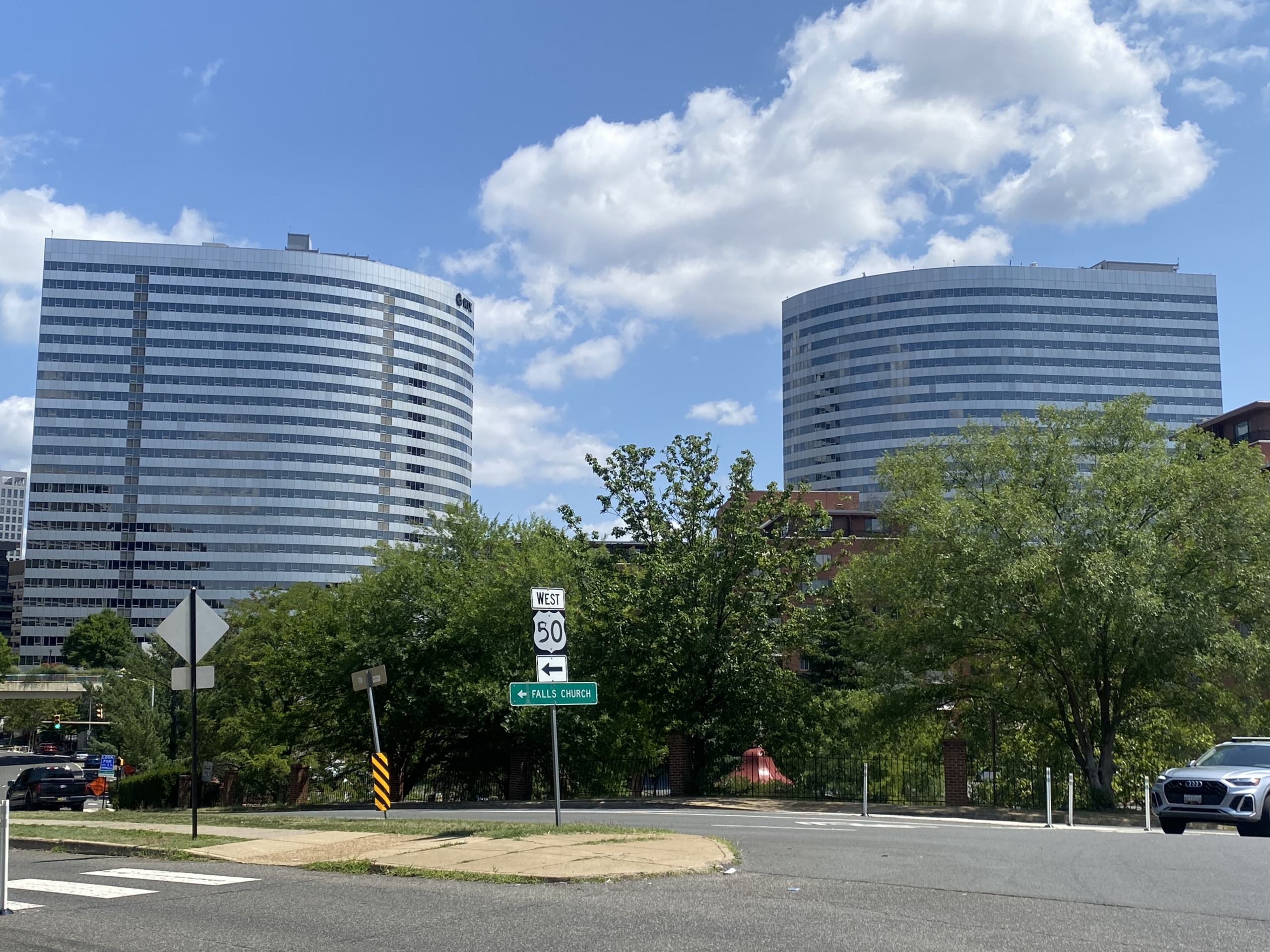
The USA Today building was located on the right.
In the summer of 1982, Arlington was the center of a bold and innovative venture in journalism – the establishment of a new national newspaper. Hundreds of reporters, editors, photographers, graphic designers and other news professionals from across the country converged on Rosslyn to create USA Today.
The newspaper was the brainchild of Al Neuharth, the chairman and president of Gannett, a large chain of small- and medium-sized daily and weekly newspapers and other media outlets. Planning had been underway for two-and-a-half years, initially in Florida and then at the Gannett News Service offices in Washington, DC. During that time, the planning staff, many of whom were borrowed from Gannett newspapers, developed a series of design prototypes and a system for satellite distribution to printing plants around the country.
Gannett needed a large block of office space for the new venture and chose six floors in a brand new silver office building at 1000 Wilson Boulevard, the tallest skyscraper in Rosslyn at the time. In October 1981, the USA Today planners moved their operation to Arlington. Two months later, Neuharth announced publicly that the first edition of USA Today would appear on September 15, 1982.
To staff the new newspaper, Gannett primarily “borrowed” journalists from its newspapers. The staffers continued to be paid by their original papers, and USA Today provided them with an additional $125 a week per diem and free housing in rented efficiency apartments in the River Place complex next door.
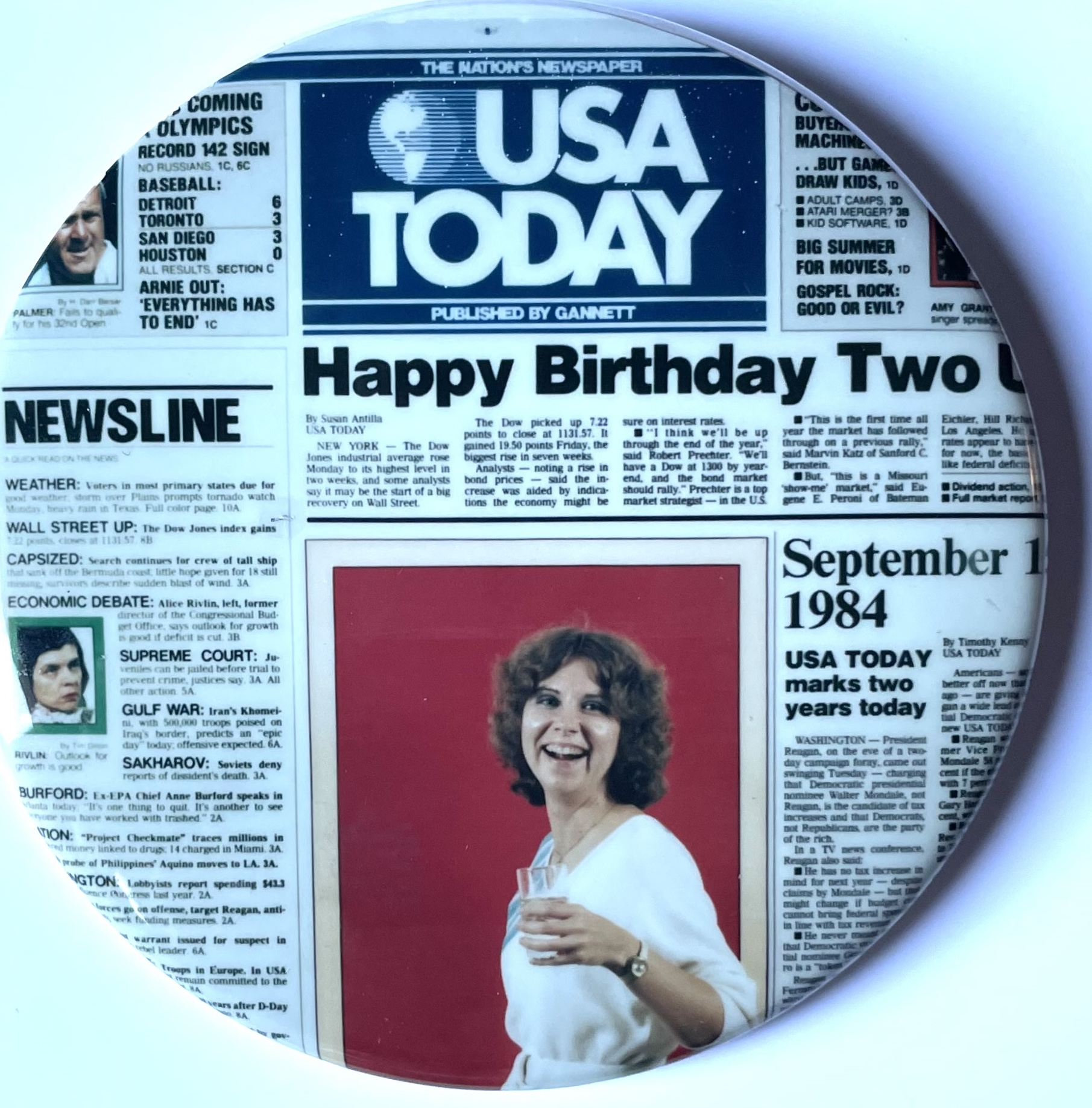
Author of the article on a two-year anniversary promotional button.
The journalists arrived in Arlington over the summer from places like Coffeyville, Kansas, and Reno, Nevada. From Monroe, Louisiana, and Marietta, Ohio. From Wilmington, Delaware, and Marin County, California. The closest were from the Washington, DC, area. The farthest was from Agana, Guam.
Since they were “on loan” from their newspapers, they became known as “loaners.” They marveled at the sleek black-and-white offices equipped with new furniture and computers. They admired the spectacular vista of the capital monuments through the large curved windows — which also provided some too-close-for-comfort views of the planes approaching National Airport. The large “USA Today” logo at the top of the building was a promise of things to come.
But before that could happen, they went through stressful weeks of writing and rewriting and re-rewriting articles for a series of prototype newspapers, as editors and reporters worked to hammer out a distinctive USA Today style. Reporters strived to prove themselves among the ever-changing demands and scrutiny from the top.The emphasis was on a national rather than local focus, which meant developing sources and getting quotes from across the country while sitting at a desk in Arlington. And doing it for a newspaper that didn’t exist yet. The staff members had been promised that their original jobs would be held for them if their USA Today experience didn’t work out, but the threat of being sent home hung over their heads.
The stress took a toll on the staff. Some developed physical symptoms, like fainting spells or hiccups so severe they required a visit to George Washington University Hospital. But at the same time, there was a camaraderie and excitement in being involved in launch of the new publication. There were weekly cocktail party “mixers” to help the journalists from around the country get to know each other. Living in Arlington without their families, staff members would go out to dinner together at the Tom Sarris’ Orleans House across the street and meet for drinks at a Rosslyn bar called The Pawnshop. The atmosphere reminded many of freshman year at college, as new friendships were formed and people explored the Washington area together.
A Washington-based Gannett News Service editor put together a list of helpful hints for the newcomers on surviving the Arlington/Washington experience. He warned them about the dangers of crossing streets in Rosslyn and the diligence of Arlington police in ticketing cars, especially those with out-of-state plates. He advised them to take the Metro — only 65 cents on weekends, and to be careful not to damage the magnetic strip on the flimsy cardboard fare cards. Booze is only sold in state-run stores in Virginia, he noted, but for for other things, the Dart Drug at Wilson and Moore “has just about anything you need.”
As the September 15, 1982, date approached, the distinctive USA Today boxes began to appear on local street corners, since the newspaper would launch first in Washington and Baltimore. Souvenirs and promotional items — T-shirts, hats, notepads, aprons, and even a toy bank in the shape of the newspaper boxes — were produced.
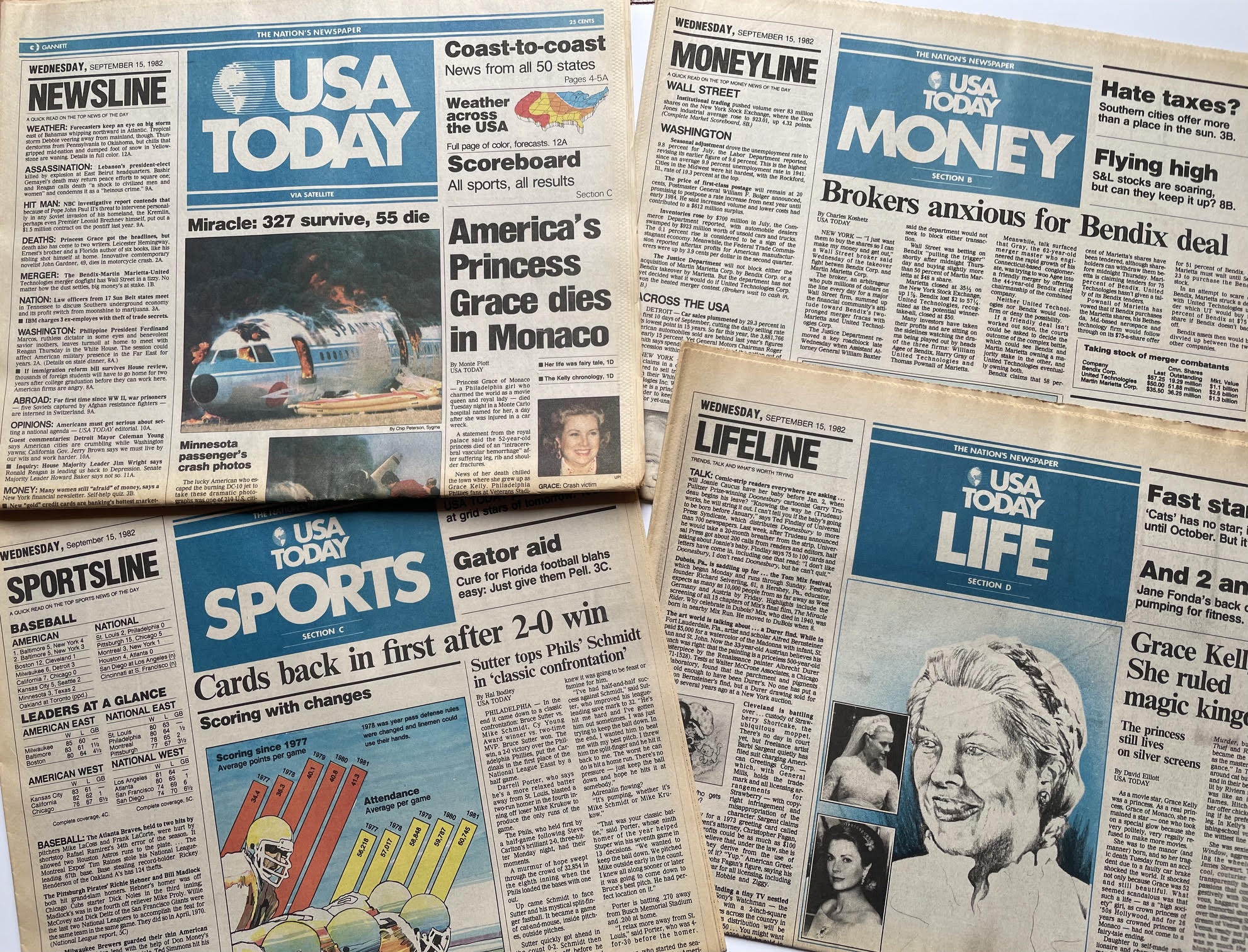
On September 14, the first edition was written, edited, laid out, and photographed in the Rosslyn headquarters and transmitted by satellite to the Army Times Publishing Co. printing plant in nearby Springfield. That evening, the staffers boarded rented buses and sipped champagne on the way to the printing plant, where they watched the first papers come off the presses.
Over the next three months, the USA Today editors decided which reporters would be offered permanent positions and which would be sent back to their original newspapers. And reporters decided whether they wanted to leave their old jobs and towns and take a chance on this new and still speculative paper. Those who took the offer had to quickly find their own housing in the Washington area. Many became Arlingtonians.
USA Today systematically expanded nationwide. Reviews of the newspaper were decidedly mixed. Critics called it “McPaper” and decried it as superficial and too rah-rah cheery. But with its lavish use of color and graphics (including its large color weather map), its news summaries and digests, and its emphasis on concise writing, it made an impact on American journalism. By 1987, USA Today circulation had passed 1.5 million, and total readership was the largest of any U.S. daily newspaper.
Ironically, although Arlington was the birthplace of this innovative newspaper, the county itself did not receive much recognition for it. Most of the extensive newspaper and magazine coverage of the launch of USA Today referred to its location as “suburban Washington” or “Rosslyn, Va.”
In 2001, USA Today moved its operations out of Arlington to the new Gannett headquarters in McLean (later moving to New York). The large blue USA Today logo came off the shiny silver tower in Rosslyn.
The author of this story, Barbara Zigli, moved from Cincinnati to Arlington as a member of the founding staff of USA Today, where she worked as a reporter and editor from 1982 to 1987. The article is based on her own recollections and additional information from the 1987 book, “The Making of McPaper,” by Peter Prichard.

